
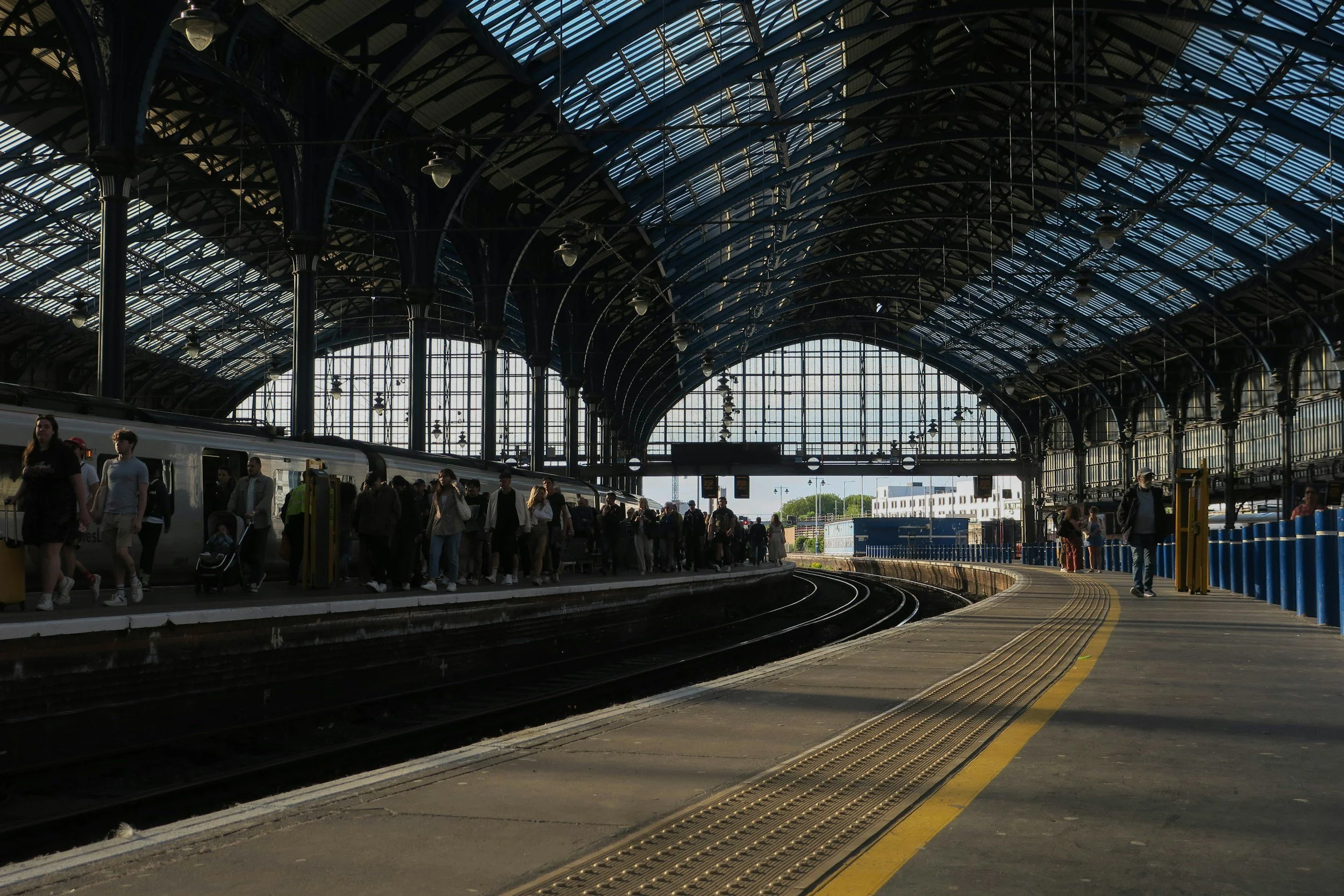
A Gateway to Gatwick - and Beyond:
ensuring the benefits of national projects are felt on the doorstep
Foreword
By Natasha Irons MP
For too long, and for too many communities, the promise of economic growth has felt like a train passing by.
Here in Croydon, we have watched from our windows as the prosperity of London and the global reach of Gatwick Airport flourish, yet our own community remains tethered to a Victorian rail infrastructure that is at breaking point. As the Member of Parliament for this vibrant, ambitious town, I see the sheer frustration of people whose lives are dictated by what we know as the East Croydon bottleneck. With 67% of trains at East Croydon currently facing delays or cancellations, the status quo is not merely an inconvenience - it is a structural barrier to the equity and opportunity my constituents deserve. But it is also a barrier to growth for the entire region.
This paper, A Gateway to Gatwick and Beyond, outlines a transformative vision that was initially sought to be delivered by the cancelled Croydon Area Remodelling Scheme (CARS) as the essential linchpin for the entire London-to-South-Coast corridor. It argues persuasively that we must move past the paradox where infrastructure happens to communities rather than for them.
The expansion of Gatwick’s Northern Runway is a significant national undertaking, but its success is inseparable from the reliability of our tracks. Without investing to expand East Croydon station, or supporting with the infrastructure across the Main Line, the airport’s goal of a 54% rail mode share remains a challenge that looks insurmountable.
The economic case presented here is undeniable: an equivalent scheme to CARS that unlocks the bottleneck and upgrades this track could unlock £5.1 billion boost to our regional economy, the support of 10,500 permanent jobs, and the unlocking of 14,500 much-needed new homes. However, for the people of Croydon, the value of a new scheme is measured in more than just GVA. It is measured in the 230,000 hours returned to commuters every year and in the long-overdue accessibility improvements at our stations. It is about ensuring that a resident in our borough can reliably reach a high-quality job at the airport or in Central London without their commute being jeopardised.
We have a rare opportunity to redefine what good growth looks like by tying global connectivity to local regeneration.
By recommitting to a scheme like CARS, the Government can signal that it understands the vital link between national ambition and the lived experience of ordinary people everywhere. This project is not a peripheral rail upgrade; it is the foundational pillar upon which the future of Croydon - and the wider South East - depends. It is time to unpause our potential, unblock our tracks, and finally turn East Croydon into the world-class gateway our community and our country require. And set it out as a model for how big infrastructure upgrades can boost their local communities.
Executive Summary
The Government has been ambitious on national infrastructure - and building the capacity of critical international airports is at the centre of this ambition. Amongst these, most critically, is the expansion of London Gatwick Airport. However, to achieve the good growth people expect to see in their lives, policymakers must bridge the gap between the national and the local. In this instance, that involves tackling the challenges faced in the local infrastructure surrounding Gatwick, and most immediately, in Croydon - the hub that acts as a gateway into Gatwick.
To do so, we argue, would catalyse a £5.1 billion economic engine designed to transform the UK’s most congested rail junction into a gateway for international trade, regional connectivity and local regeneration, and unleash the potential of the wider Croydon Opportunity Area as well as - we argue - the entire region and a significant knock on effect for the national economy as a whole. But to achieve this also requires addressing a critical bottleneck in local rail.
We argue for investing in a new Gateway to Gatwick scheme that seeks to untangle the ‘Croydon bottleneck’, in order to demonstrate that major infrastructure projects can be connected to the communities around them. The Gatwick expansion can be connected to the people most affected, and with the most to benefit. This offers a model of tangible, good growth. Not just in Croydon, but across the South East and UK.
Why it matters
A highly congested junction dubbed the Croydon Bottleneck stands between stagnation and realising enormous economic potential for the local community and country. The crisis at the heart of the Brighton Main Line (BML) - the Croydon bottleneck - is both a technical failure and a symbol of a deeper national disconnect. Since the cancellation of the Croydon Area Remodelling Scheme, which promised to expand the station and redress faulty track layouts, this enormous challenge remains unaddressed. This means:
The immediate crisis: Currently, 67% of trains at East Croydon are delayed or cancelled. Because tracks cross on a single level at the Victorian ‘Selhurst Triangle’ - dubbed the Croydon bottleneck - a delay of just a few minutes to one train ripples down the line, halting travel from London to the South Coast. This puts at risk the recent announcements from the Department for Transport to increase frequency of services to Gatwick. But it also threatens the ability to deliver projects such as Luton expansion through to the new Universal Park.
The strategic deadlock: Without a similar scheme to CARS, the UK’s wider infrastructure ambitions are stalled. The £2.2 billion Gatwick Northern Runway expansion is legally and operationally contingent on a 54% public transport share - a target that is physically impossible to meet as long as the Croydon bottleneck remains.
Tackling the national project and local impact gap: For too long, Britain has treated major infrastructure as something that happens through communities rather than for them. In Croydon, this creates a stark paradox. Residents can see the planes descending into Gatwick and the trains racing south, yet their own journeys are stalled by crumbling tracks and chronic delays. The opportunity is physically on their doorstep, but functionally out of reach. CARS represents a shift toward good growth, ensuring that global connectivity - like the Gatwick runway expansion - is used to solve from the last mile transport gaps to the accessibility deserts that cut too many people off from the benefits of growth.
The impact
Addressing the Croydon bottleneck could unlock huge benefits from the Croydon Opportunity Area:
Economic value: A projected £5.1 billion GVA boost over 20 years by unlocking all benefits of the Croydon Opportunity Area, significantly outperforming earlier estimates of £4 billion.
Job creation: Unlocking this could support 10,500 permanent jobs, contributing up to £845 million annually to the economy by completion of the upgrades, plus a £443 million immediate boost during the initial construction phase.
Housing & regeneration: Unlocks the delivery of 14,500 new homes on brownfield sites as part of a wider £5.25 billion regeneration of Croydon’s town centre.
Productivity: Addressing the average commuters 230,000 hours annually, returning £44 million alone each year in economic value by converting ‘lost time’ into productive or personal hours.
The solution
A full upgrade of the local infrastructure around Croydon East Station to tackle the bottleneck with new streamlined, high-capacity infrastructure via a new Gateway to Gatwick Scheme, and could include:
A brand new piece of infrastructure: A redevelopment of East Croydon station, adding two new platforms and a significantly larger concourse to handle the projected rise in passenger numbers.
Rail transformation: The construction of new rail connections to remove the flat junction known as the ‘Selhurst triangle’ and remove the bottleneck.
Local connectivity: Integration of the last mile through a new East-West Galleria, step-free access at Norwood Junction, and the gradual replacement of the country's oldest trams.
Introduction
Britain has been at a standstill. After more than a decade of stalled infrastructure delivery, the Government has rightly focused on unlocking new critical infrastructure to boost economic growth across the country. Airports, railways and energy projects once stuck in the planning pipeline are finally moving again. However, to fully realise the potential of major infrastructure projects, we need more than scale. We need the associated growth to be experienced within local communities. Projects that promise national benefit while doing little to improve the locality in which they reside, risk reinforcing the perception that growth happens around communities - not for them.
The recent approval of the privately-funded £2.2 billion Gatwick Northern Runway project promises significant economic growth for the South East, including an estimated £1 billion annual boost and 14,000 new jobs [1]. But the success of this expansion depends as much on translating these headline figures into tangible local prosperity as it does on what happens on the runway.
East Croydon station sits at the heart of one of the busiest rail corridors in the country. It’s the primary junction through which all rail services to Gatwick must pass including vital services between London Victoria and Brighton, through to brand new projects such as Universal Park, and one of the most heavily used stations in Britain - busier even than Gatwick Airport station itself.
It also sits on a bottleneck that Network Rail has consistently identified as one of the most severe capacity and reliability constraints on the national rail network [2].
Operating with just six platforms, and a complex series of flat junctions, it has long constrained the Brighton Main Line. Delays at East Croydon routinely ripple across the network, undermining reliability for hundreds of thousands of passengers daily and limiting the ability to run additional services as demand grows.
This means that, as things stand, the recent announcements by the Department for Transport for increasing services to Gatwick as operators are pulled into public control could face significant hurdles to realisation without addressing the infrastructure challenges [3].
The Croydon Area Remodelling Scheme (CARS) was a proposal developed to resolve this problem [4]. Designed as a comprehensive intervention rather than a marginal upgrade, the scheme would expand East Croydon from six to eight platforms, introduce separated junctions to remove conflicting train movements and modernise track layouts and station facilities, and evidence suggests that CARS could unlock thousands of additional seats per hour on the Brighton Main Line whilst delivering significant long-term economic benefits.
Importantly, CARS was not meant to be just a rail upgrade. It was conceived to enable investment, catalysing the Croydon Opportunity Area, unlocking new homes and jobs and anchoring wider regeneration in the borough. A public Network Rail consultation showed overwhelming support for the scheme, and local government and business leaders have repeatedly linked its delivery to Croydon’s growth ambitions [5].
Despite this, CARS was formally paused in 2022 and remains without committed funding or a delivery timeline [6]. Since then, Gatwick’s expansion plans have accelerated and pressure on the Brighton Main Line has intensified. With Gatwick forecast to grow significantly even without a second runway, the cost of inaction is now rising sharply and being felt deeply in the local communities this line should serve.
These dynamics have political consequences. In places like Croydon, where residents can see a national economic asset on their doorstep but experience worsening congestion and unreliable services, frustration with the system is growing. This disconnect between headline growth and lived experience creates fertile ground for populist politics.
Recommitting to a scheme similar to or delivering elements of CARS for realising the full Croydon Opportunity Area’s potential offers a clear alternative. By tying Gatwick’s expansion to tangible improvements in everyday journeys and local regeneration, the Government can demonstrate that growth can be visible, fair and locally beneficial. Doing so would not only unlock the full economic potential of the Gatwick corridor as well as the wider region, but also help close the political vacuum that emerges when promised opportunity fails to materialise.
Context: Gatwick and the surrounding corridor
London Gatwick Airport's strategic importance as a global gateway is set to increase significantly with the delivery of the Northern Runway project. As the UK’s second-busiest airport, Gatwick already plays a vital role in national connectivity, trade and tourism. Expansion has the potential to amplify these benefits, supporting jobs, investment and productivity across the South East and beyond. But as with all major infrastructure projects, success will depend not only on what is built, but on how well the surrounding system adapts to absorb the growth it generates - and how successfully this growth is dispersed to local people.
The Gatwick corridor is central to this challenge. Stretching from the South Coast, through Sussex and into south London, it is the primary route through which the economic effects of airport expansion will be felt. For growth to be inclusive and durable, the infrastructure that connects people to Gatwick - particularly rail - must be able to support increased demand reliably and at scale, and be able to deliver jobs and new connections for local people. Without this, the risk is that expansion concentrates benefits within the airport boundary, while pressure is placed on local communities with no reward.
Croydon sits at the heart of this corridor. It already acts as the key gateway between Gatwick and Central London, with every rail service that connects the capital to the airport passing through East Croydon. The borough is therefore the gateway to growth in the corridor. This valuable position already delivers tangible benefits: airport activity contributes an estimated £265 million annually to Croydon’s economy and supports over 3,600 local jobs [7]. Unsurprisingly, the borough's political and business leadership has consistently welcomed the expansion as crucial to the wider Croydon Growth Plan.
But, this relationship is finely balanced. The same rail corridor that underpins Croydon’s economic strength also represents its greatest chokepoint. The Brighton Main Line is one of the busiest railways in the country [8], yet it runs through Croydon on infrastructure that is operating at or near capacity. Reliability issues at this single point are felt across the entire network, constraining service frequency, increasing journey times and reducing resilience during disruption. As passenger demand continues to recover and grow post-Covid, and as Gatwick expands further, these pressures will undoubtedly intensify.
Meeting the capacity demands created by Gatwick’s expansion therefore rely on strengthening the infrastructure that runs through Croydon. Investment along the Brighton Main Line isn’t simply about accommodating more passengers to and from the airport; it’s about ensuring the growth generated by the Northern Runway project is translated into tangible benefits for the communities that sit along the corridor. Without targeted intervention, the risk is that Croydon and surrounding areas experience the costs of expansion without sharing in its rewards.
Improving rail capacity and reliability through Croydon is essential to making Gatwick’s expansion work economically and politically. By aligning airport growth with visible improvements in everyday connectivity for locals, the Government has an opportunity to demonstrate that major national infrastructure projects can deliver real, local gains - reinforcing confidence that growth is something communities participate in, not just a train that passes through.
The regional and national knock-on
The Croydon bottleneck - it is clear - is not just a Croydon and Gatwick challenge, nor even a London and South East one. East Croydon sits on the Thameslink line, which runs as a single service from Bedford to Brighton. A delay of a few minutes at the Selhurst Triangle soon reaches as far as Luton, St Albans and Bedford. Every day, the bottleneck holds back a corridor that links the East of England, London and the South Coast - a pivotal economic corridor that, if blocked, has significant repercussions for the UK as a whole.
That corridor is about to carry substantial parts of the Government’s growth agenda.
Gatwick’s Northern Runway sits at its southern end. At its northern end, the Government has also approved Luton Airport’s expansion, raising its passenger cap from 18 million to 32 million a year by the mid-2040s [9].
And in Bedford, Universal’s first European theme park and resort is set to open in 2031 and expects 8.5 million visitors in its first year, more than any attraction in Europe bar Disneyland Paris. Accompanying this project is an expanded four-platform station at Wixams, on the same Thameslink line that runs through East Croydon [10].
All three projects will draw on the same stretch of track. Holidaymakers heading to Bedford from Gatwick, south London, Sussex and the South Coast will pass through Croydon. Workers and passengers travelling to Luton and Gatwick will rely on the same services. Each scheme adds pressure to a line whose weakest point is the junction outside East Croydon.
Gatwick, Luton and Universal were each approved because of what they will deliver for the national economy. Without action at Croydon, all three will share a single bottleneck, and the communities along the line will bear the costs of growth without seeing its rewards. A new Gateway to Gatwick scheme is the keystone that makes those investments work, so that the benefits reach Bedfordshire and Hertfordshire as well as Surrey, Sussex and south London. For these communities, this is not just a local project, but one that connects major projects to their own livelihoods.
This is what good growth looks like in practice. Homes are built where the transport already is. Major national projects strengthen the communities around them rather than passing them by. The benefits of a runway in Sussex, an airport in Luton and a resort in Bedford are felt on doorsteps right along the line.
Universal UK and the Case for Integrated Regional Infrastructure
The recently announced Universal UK resort represents one of the largest private sector investments in the South East. Like Gatwick's expansion, it will create tens of thousands of jobs and drive significant economic activity. However, its success depends on the same critical infrastructure: reliable, high-capacity transport connections linking workers from across the region to the site.
The Croydon bottleneck poses the same strategic constraint for Universal as it does for Gatwick. Workers from deprived communities in South London and beyond who might access employment at Universal face unreliable commutes through the same jammed junction. A region that invests in addressing this bottleneck therefore unlocks value not just for one major employer but for multiple growth opportunities simultaneously.
This illustrates a wider principle: major infrastructure investments should not be treated in isolation. By fixing the Brighton Main Line now, the Government can position the entire South East's growth pipeline - airports, attractions, logistics hubs, and new employment centres - to function as an integrated economic zone. Communities currently cut off from opportunity by unreliable transport gain access to multiple pathways to prosperity, not just one.
This is why the Croydon bottleneck is not simply a Gatwick problem. It is the key to unlocking the South East's full growth potential across multiple sectors and ensuring that growth is widely distributed rather than concentrated. And importantly, it demonstrates a broader commitment to ensuring local communities are benefitting from larger projects on their doorstep.
The Challenge of Crumbling Infrastructure: The Croydon Bottleneck
The economic promise of Gatwick's expansion - and projects even further afield - is already throttled by existing pressures on local infrastructure. Without intervention, the increased demand generated by the Northern Runway project risks overwhelming systems that are already operating at their limits, preventing the wider region from fully capturing the benefits of growth. Nowhere along the line is this more acute than at the ‘Croydon bottleneck’ [11].
East Croydon station sits at the centre of one of the most intensively used rail corridors in the country. But, with just six platforms and a complex series of flat junctions, the station jams up the system instead of acting as the crucial hub it could be..Trains must cross each other’s paths to move through the junction, significantly limiting throughput and leaving little margin for error. As a result, even minor disruptions routinely propagate across the wider Brighton Main Line, affecting services far beyond Croydon itself and undermining reliability for more than 300,000 daily passengers [12].
The issue is purely structural. Network Rail has consistently identified the Croydon junction as one of the most severe capacity performance constraints on the national rail network. As passenger numbers recover to near pre-pandemic levels and continue to grow, this issue increasingly dictates what the network can deliver - capping service frequency, reducing resilience and limiting the ability to respond to rising demand.
The original solution - the Croydon Area Remodelling Scheme (CARS)- was proposed to:
Expand East Croydon Station from six to eight platforms.
Introduce new grade-separated junctions (flyovers and dive-unders) to eliminate conflicting train movements.
Modernise track layouts and concourse facilities, such as lifts and other accessibility features [13].
The objective was to unlock additional capacity on the Brighton Main Line and restore reliability to a corridor that underpins both commuter travel and airport connectivity.
Despite widespread support and initial consultation phases, the CARS project was formally paused in 2022 and remains without committed funding or a clear delivery timeline [14].7
In the absence of intervention, Gatwick's capacity growth will immediately place unsustainable strain on an already fragile infrastructure system, leading to greater unreliability and directly undermining the economic promise of the expansion.
Left unsolved, CARS or otherwise, the Croydon bottleneck risks becoming the defining problem for the Gatwick corridor - turning a nationally significant growth opportunity into a source of mounting disruption and frustration. Left unresolved, the Croydon bottleneck will determine whether Gatwick’s expansion delivers growth in practice, or remains an ambition undermined by the system meant to support it.
The problem with selling Gatwick and national projects expansion in isolation
Airport expansion often faces public resistance, largely centred on environmental concerns, but also due to the perception that local communities absorb all the negative consequences - noise, traffic, potential pollution - while the economic benefits are centralised at the airport. Rarely are there any perceived cascading economic benefits for local people.
The current challenge in Croydon is that the massive employment opportunities - 14,000 new jobs [15] - remain physically disconnected from the large local talent pool due to an unreliable commute. Moreso, the expansion is also likely to have an adverse effect on the already struggling rail lines leading into it: with increased services, delays could even worsen and daily frustrations will grow.
In short, it is difficult to sell a £2 billion regional boost to residents whose daily journeys are constantly jeopardised by the ‘bottleneck.’
To gain local buy-in and realise its full economic and social potential, the expansion must be reframed. The investment must not stop at the fence; it must follow the commuter route and land in the surrounding communities along the entire Main Line. This means tying it to a recommitment to new investment in expanding East Croydon’s station and bolstering the Brighton Main Line.
Marrying Big and Small: A New Gateway to Gatwick Scheme in Croydon
This policy proposes an urgent strategic shift: transforming East Croydon Station into an integrated transport and commercial hub that formally links Croydon's metropolitan centre to the airport’s global status by unlocking the entire route currently strangled by its bottleneck. This, we believe, will catalyse the wider Croydon Opportunity Area on an accelerated timeline. But addressing the route also connects this Area to other major projects in tandem.
We therefore propose the Government look at a new Gateway to Gatwick Scheme modelled on CARS or the most cost-effective elements of it.
This could provide, if delivered in full:
A world-class Interchange: The expansion of the station is more than a rail project; it creates a modern, spacious interchange linking heavy rail (Gatwick Express, Thameslink, Southern) with Croydon’s Tramlink system, buses, and active travel routes.
An ‘Absorption Hub’: With eight platforms and reliable, separated services, East Croydon becomes the logical ‘gateway’ where Gatwick’s vast workforce and business travellers reliably flow. This reliability is paramount for employees travelling from South London and beyond - as well as users of the Gatwick Express - to reach their jobs on time without having to tackle the existing bottleneck.
Transit-Oriented Development (TOD): The expansion creates the necessary certainty and space for the proposed mixed-use development above and adjacent to the station - new homes, offices, and retail - fully integrating the station into the ongoing regeneration of central Croydon.
This investment reframes Croydon not just as a bedroom community to Gatwick, but as an essential, high-functioning logistics and labour hub critical to the airport's operational success, as well as allowing for a fast flowing rail line overall to other key projects.
Executive Summary: the economic case for a new scheme that catalyses the Croydon Opportunity Area
Based on challenges tackled by CARS
Total GVA impact: A projected £5.1 billion Gross Value Added (GVA) boost over 20 years for catalysing the Croydon Opportunity Area, significantly exceeding previous estimates of £4 billion for the original CARS scheme impact analyses.
Job creation: The project is expected to support 10,500 permanent jobs in the long term, contributing approximately £845 million annually to the economy once fully realised.
Infrastructure investment: A strategic investment to unblock the ‘Croydon Bottleneck’, one of the UK’s most critical rail constraints, which could be supported by uplift from Gatwick and other funding mechanisms, and is well exceeded by the ROI.
Reliability improvements and hours saved: Transforming East Croydon from a station where 67% of trains were delayed or cancelled in 2024 to one in line with national averages, saving commuters 230,000 hours annually.
Necessary to meet targets: Critical to the success of the £2.2 billion Gatwick Northern Runway expansion, ensuring the airport meets its target of 54% passenger rail use.
Regeneration: Unlocks the delivery of up to 14,500 new homes and anchors a wider £5.25 billion regeneration of the Croydon town centre.
The Croydon Opportunity Area (COA) represents one of the UK’s most significant untapped engines for economic growth. The COA is identified in the Mayor’s Plan, which when delivered, the Plan agrees, would support thousands of new jobs and homes [16]. But realising its potential requires a strategic shift: moving away from stalled, large-scale rail concepts toward a phased, high-impact investment in the Gateway to Gatwick. By modernising the infrastructure at the heart of the Brighton Main Line - specifically through an expanded East Croydon station and targeted track improvements - the government can unblock a national bottleneck while finally delivering the dividends of growth to the local community
The Economic Engine: Realising £5.1 Billion in Value
The economic case for prioritising the Croydon Opportunity Area is both compelling and urgent. By delivering the core infrastructure improvements required to unleash the COA, the project is projected to return a 20-year economic benefit of £5.1 billion. This is larger than prior estimates.
This valuation reflects a sophisticated understanding of how increased rail reliability and station capacity act as a catalyst for wider regeneration. On a local level, the project serves as a powerful economic stimulant:
Construction: Targeted infrastructure works are estimated to provide a £443 million boost to the regional economy through the employment of thousands of workers.
Long-term employment: By acting as the primary enabler for the COA, accelerating the realisation of the COA would support the delivery of up to 10,500 permanent jobs.
Annual GVA: Once fully realised, these new employment opportunities will contribute approximately £845 million annually to the Gross Value Added (GVA), creating a sustainable cycle of local wealth.
Removing the bottleneck: national connectivity
While the jobs are tied to the wider Opportunity Area, the economic impact of reduced delays is directly attributable to station and track upgrades. East Croydon currently functions as a systemic bottleneck; as one of the worst-performing stations in the country, 67% of its trains suffer from delays or cancellations due to outdated layouts.
This inefficiency has national repercussions. Every rail service to Gatwick - a critical international gateway - must pass through this single junction. For Gatwick to meet its public transport targets following its £2.2 billion Northern Runway expansion, the capacity of the Croydon corridor must be transformed. By bringing performance in line with national averages, targeted investment in station capacity and the Selhurst Triangle will generate £440 million in economic value through time savings and improved logistics alone.
A blueprint for good growth
Realising the Croydon Opportunity Area is a story of good growth - development that is inclusive, sustainable, and deeply integrated into the town's fabric. Transforming East Croydon from a point of frustration into a modern gateway serves as the anchor for a wider £5.25 billion regeneration of the town centre.
By removing the Bottleneck, there is a way to not only support direct jobs and have an immediate impact on delay reduction, but it positions Croydon as an intra-transport hub that could attract new jobs, leisure and homes.
We believe this could unlock, based on previous estimates of how CARS could attract investment:
14,500 new homes across the Opportunity Area, not accounting for the wider London Plan above.
The conversion of derelict brownfield sites into vibrant commercial units and public spaces, such as the proposed East-West Galleria.
Improved local accessibility, including essential step-free access at hubs like Norwood Junction.
By focusing on a new Gateway to Gatwick scheme - even in elements - as the key to the Croydon Opportunity Area, the government can move past an era of stalled delivery. This approach allows for a modular, achievable investment that bridges the gap between local needs and national ambitions, ensuring that the UK remains a competitive destination for international business as well as an efficient intersection to other major projects.
Recommendations
To immediately seize this economic opportunity and ensure its benefits are tangibly realised in the local, regional and even national economy, we recommend the following:
1. Recommit and prioritise a new Gateway to Gatwick Scheme
The Government and Network Rail must formally re-engage on an upgrade based on CARS or components of it dependent on funding, and re-emphasise its priority within national infrastructure planning given its significance to ensuring Gatwick expansion is successful. It should be designated as a critical enabling project for the success of the Gatwick expansion, not a peripheral rail upgrade.
A new Scheme include in full or in elements:
Expanding East Croydon Station from six to eight platforms.
Introduce new grade-separated junctions (flyovers and dive-unders) to eliminate conflicting train movements.
Modernise track layouts and concourse facilities, such as elevators and other accessibility features.
The prioritisation of each of these elements must be considered by the funding mechanism, but the junction transformation is the most significant aspect for reducing delays from the Bottleneck overall.
2. Establish a Dedicated Funding Mechanism: a Mutual Investment Model
A dedicated funding stream must be secured. The CARS scheme, if fully realised, was likely to cost in the region of £2.9 billion under the previous estimates [17]. It is worth noting that the cost is now likely to be lower as some of the initial construction for certain elements has already been completed under different schemes.
Still, it should be recognised that, even with GVA realisation, there is some upfront cost to the delivery of a full realisation of a scheme similar to CARS.
Any upfront cost can be sequential and based on phases. This includes sequencing elements of the original Scheme based on those that are most likely to reduce delays and turbocharge job creation and agglomeration, and this includes first and foremost grade separation and addressing the Selhurst Triangle as a priority.
How a Mutual Investment Model (MIM) would work
A Mutual Investment Model (MIM) should be established through a dedicated Development Corporation. This vehicle will act as the central mechanism to pool capital from various investors, manage delivery risk, and coordinate a phased, multi-layered funding stack split between key strategic beneficiaries.
Under this model, central government, local authorities, the aviation sector, and private operators will each finance and recoup their respective portions through targeted mechanisms. There can be a choice as to which mechanisms they utilise.
The public sector contribution could utilise a combination of national and local mechanisms. Central Government can provide direct capital grants or first-loss catalyst financing through the UK Infrastructure Bank (UKIB), treating the scheme as a critical national asset that protects airport connectivity. HMG will recoup this investment indirectly via general national taxation from the resulting 10,500 permanent jobs and £845 million annual GVA injection. Locally, the Mayor of London and local authorities can deploy Tax Incremental Financing (TIF) alongside local planning levies. These investments will be recovered through Business Rate Supplements (BRS) applied to commercial properties within the Croydon Opportunity Area, alongside the aggressive ring-fencing of Section 106 agreements and Community Infrastructure Levies (CIL) from the 14,500 planned town centre homes.
The aviation sector and private markets also have an array of options to support, and a few ways to recoup the cost in the long term. Gatwick Airport can contribute through an operational infrastructure levy or throughput contribution fee on airline landing slots. Because its £2.2 billion Northern Runway expansion is legally contingent on hitting a 54 per cent rail mode share target, Gatwick would absorb this as a cost of compliance, recouped via expanded aeronautical revenues. Alternatively, a time-limited passenger surcharge or localised Air Passenger Duty (APD) supplement of £0.50 to £1.00 on departing flights could be utilised to directly link airport users to this vital transit corridor. Simultaneously, institutional investors and major landowners like Westfield can provide upfront capital in exchange for Transit-Oriented Development (TOD) rights. This private funding will be recouped through long-term commercial ground rents from high-density towers and direct retail integration within the proposed East-West Galleria.
Finally, transport providers, users and the broader local community will directly participate in and benefit from this shared investment. Train operating companies can manage their commitments through marginal infrastructure premiums integrated into Brighton Main Line ticket pricing. Passengers will recoup this cost through a drastic increase in service reliability, as resolving a bottleneck where 67 per cent of trains face delays saves commuters 230,000 hours annually, yielding £440 million in economic value. Local businesses and residents will similarly recoup localised contributions through a massive uplift in asset values and footfall driven by the wider £5.25 billion regeneration of Croydon’s town centre, alongside direct local dividends like step-free access at Norwood Junction.
Ultimately, blending these options ensures the financial burden is diversified, ensuring that every stakeholder pays in exact proportion to the direct economic or operational reward they capture.
3. Integrate Land Use and Transport Planning
Croydon Council must work with Network Rail and future developers to ensure the expanded station design maximises the potential for Transit-Oriented Development, specifically planning for the integration of new residential and commercial units above and adjacent to the new concourses, solidifying East Croydon's role as a major economic gateway.
Conclusion: a model for the future
Government investment in expanding important national infrastructure projects, such as Gatwick Airport or even new theme parks, is essential for the wider growth story it is seeking to tell. So too is its ambition to simultaneously improve the frequency of services to the airport and major nearby projects, as was recently announced. However, to genuinely see the good growth impacts of such projects - to bridge the gap between national and local growth - it is local infrastructure and the surrounding community that must also benefit.
For Gatwick expansion, a new Gateway to Gatwick Scheme is the essential link required to translate national airport expansion into widespread regional prosperity via the COA. And it can be a model for how to tie the national to the local right across the country.
While the expansion of Gatwick offers significant growth, its success and the extent to which it will benefit the local community is physically throttled by local infrastructure and the Croydon bottleneck, where 67% of trains currently face delays or cancellations. By investing to unblock this critical junction, the Government can secure a projected £5.1 billion Gross Value Added (GVA) boost over 20 years - far exceeding previous estimates.
This investment ensures that the economic engine of the airport does not operate in isolation, but instead drives a steady state of 10,500 permanent jobs and an annual £845 million contribution to the regional economy.
Ultimately, restarting a scheme such as this provides a model for good growth by ensuring that major infrastructure benefits are felt directly on the doorsteps of local communities. Beyond its role in national connectivity, the scheme serves as the primary anchor for a £5.25 billion regeneration of Croydon’s town centre, unlocking the delivery of 14,500 new homes and transforming derelict brownfield sites into vibrant commercial hubs. By modernising the heart of the Brighton Main Line, the Government can bridge the gap between national ambition and local lived experience, ensuring that the wider economy thrives through a rail network that is reliable, inclusive and capable of supporting the UK’s long-term growth.
It is through projects such as this that the Government can demonstrate how to successfully link larger projects with the communities around them. By supporting this scheme, the Government can showcase an understanding of the need for larger infrastructure projects to support real, tangible growth on the ground.
Appendix: economic methodology
1. Total Economic Impact (GVA)
The projected £5.1 billion Gross Value Added (GVA) is calculated over a 20-year appraisal period and based on three primary variables: job creation, reliability and regeneration.
Previous estimates: Earlier 2018/19 models projected £4 billion.
Updated calculation: The 27.5% increase to £5.1 billion accounts for revised Department for Transport (DfT) "Value for Money" (VfM) frameworks, which now place a higher economic weight on reliability-led GVA and the wider economic impacts (WEI) of densification in urban centres.
Formula: Total GVA = Direct Benefit + Time/Reliability + \Indirect Benefits and Agglomeration + Induced Impacts.
2. Job Creation & Employment GVA
The project distinguishes between temporary construction benefits and long-term steady state economic contributions.
Construction phase: Estimated £443 million boost on initial CARS estimates. This is derived using a standard multiplier effect on the £2.9bn capital expenditure (CAPEX), assuming a specific percentage of local procurement and labor.
Permanent jobs: 10,500 jobs.
Direct: Operations and station management.
Indirect/Induced: Jobs created through the 14,500 new homes and the £5.25bn town center regeneration.
Annual contribution: The £845 million annual GVA is calculated by multiplying the 10,500 jobs by the average GVA per worker in the Professional, Technical, and Service sectors specific to the London/South East corridor.
3. Reliability and Passenger Time Savings
The Croydon Bottleneck currently causes a ripple effect across the Brighton Main Line.
Current performance: Data shows 67% of trains are late or cancelled at East Croydon.
Time savings: 230,000 hours annually for commuters.
Monetisation: Using the DfT’s Value of Travel Time Savings (VTTS), where passenger time is assigned a monetary value based on the split between business, commuting, and leisure travel.
Economic value: This equates to £440 million in economic value over the appraisal period by reducing "dead time" for the workforce.
4. Infrastructure and Gatwick Connectivity
The CARS project is the primary enabler for the Gatwick Northern Runway expansion.
The 54% target: Gatwick's expansion is legally/operationally contingent on a 54% rail mode share.
Constraint mapping: Without the Selhurst Triangle and East Croydon remodeling, the Brighton Main Line reaches 100% capacity by 2030.
Working: The CARS project adds the necessary pathways to allow an additional 4–6 trains per hour, providing the capacity required to move the projected increase in international passengers without collapsing local commuter services.
5. Regeneration and Housing
The £5.25 billion regeneration figure is anchored by the station’s redevelopment.
Housing yield: The 14,500 homes are calculated based on the unblocking of brownfield sites (e.g., the East-West Galleria) that are currently undevelopable due to railway land constraints or poor accessibility.
Infrastructure-led development: A 1:1.8 ratio is applied here; for every £1 spent on the CARS transport hub, it is estimated to attract £1.80 in private sector investment in the surrounding Croydon Opportunity Area.
With thanks to
Christos Tsoukalis
Natasha Irons MP
Jade Azim