
August 2026
Investing in Agency
A Menu of Options for Health Benefits Claimants
“You should look at providing services and resources and actual help for people.”
- Woman, Mental Health Nurse, 53, Staffordshire, Labour-Green switcher

Executive Summary
What does someone actually need to live the fullest life they possibly can, and how does the state help them get there? That is the question the welfare debate should be answering. The answer is to offer agency, moving away from a passive system that maintains people where they are, to an active one that invests in where people could be.
When we polled the recipients of health and disability benefits, including PIP, ESA, and UC Health Journey, we found that there was significant appetite for a system which offers more choice. Nearly half would voluntarily exchange part of their cash benefit for services like home support, physiotherapy, therapy, or skills training.
This model already exists. The Motability Scheme has operated for 40 years on the principle that claimants can exchange part of their benefit for a service the state procures at better than market value. Nobody loses cash unless they choose to. We propose extending that logic to a wider menu of services, such as home support, therapy, skills training, job coaching, home adaptations, which would be designed with Disabled People's Organisations and piloted by DWP. The services our polling shows people want most already match or exceed Motability's 15.4% participation rate.
With our Menu of Options, the safety net stays intact. But for those who want more than cash, this gives them a genuine choice the current system denies them.
Key Findings
Nearly half (49%) of claimants would exchange at least £20 a week of their cash benefit for at least one service; one in three (31%) would exchange at least £50.
Younger claimants (aged 16-34) are more likely to opt for a service over cash, and more keen on employment-focused services:
Every option on the menu attracts at least a quarter at £50 a week.
30% would exchange £50 a week for training, 28% for therapy, and 25% for job coaching - roughly double the overall claimant average.
ESA claimants show the highest appetite for non-cash services, running 7-14 percentage points above PIP claimants across the full menu.
Among claimants who could work, demand for training and therapy is roughly three times higher than among those who cannot, suggesting the menu can open routes back to work where applicable.
Home support, physiotherapy, and home adaptations all match or exceed the 15.4% Motability participation rate at the £50 threshold, proving the exchange model works for a much wider menu.
Our research shows the state is best placed to procure cost-effective solutions. For the 3.4 million individuals estimated to take up at least one service, the annual cost of coordinated public provision is estimated at £6.58 billion - which sits within the existing envelope. Crucially, if these same individuals were to seek these identical services through the private market, the cost would increase to £9.79 billion annually. We therefore believe there would be long term savings.


Part 1
The Wrong Debate
The national conversation on welfare has become trapped. Debate after debate starts from the same place - the size of the bill - and arrives at the same destination: an argument about numbers, with the people the system is designed to serve barely featuring. Nearly two thirds of claimants (63%) say the system needs to change to work better for people like them - including a quarter who say it needs major change. What claimants actually need, and what would help them live fuller lives, goes unasked and often unanswered.
The result is a system that is failing on its own terms. Nearly two thirds of claimants (63%) say it needs to change to work better for people like them. Three in five (61%) say the amount they receive is less than enough. Among those whose health has limited their earnings (half the claimant population), four in five (78%) say payments do not fully replace the income they have lost. Far from being a comfortable alternative to work, two thirds (65%) of out-of-work claimants say they are financially worse off than when they were working. The single largest group of claimants (36%) lives on between £100 and £199 per week. For most, cash benefits are a cost of living lifeline, which is why any alternative must be strictly voluntary.
The system compounds this by offering little beyond cash. Many of the services that could make a real difference, such as home adaptations, therapy, physiotherapy, skills training, are either unavailable through the system or unaffordable on it. Claimants are left to navigate a complex private market alone, at retail prices, with money that doesn't stretch.
For many, the barriers to work are concrete and nameable. Seven in ten (70%) out-of-work claimants say their condition made working difficult or risky. Nearly half (45%) say their health varied too much to work consistently. One in eight (12%) could not access the treatment or therapy they needed to keep working. Yet six in ten (60%) claimants have never engaged with any government employment support scheme.
The support that could change this is not currently on offer. The cash the state already commits to claimants could, for those who want it to, buy something more useful than cash alone. The question is whether the system is designed to make that possible.
The public sees the same failure. Speaking to the public as a whole, twice as many say the benefits system performs poorly at “giving people the right kind of support, not just cash” (41%) as say it performs well (24%), and 40% say it performs poorly at helping people with health conditions return to work, against 23% who say it performs well. Tellingly, the public rates the system better at providing financial security (35% well) than at providing the right support — the gap the menu is designed to close. And asked what disability benefits should primarily be for, 64% of the public choose independence, skills or contribution — nearly three times the 23% who choose simply avoiding hardship. The public’s ambition for the system matches claimants’ own.


Part 2
A New ‘Menu of Options’
“In addition to [the money], because… to just say that’s all, your only choice is a course, or you’re on your own — I think that’s probably a bit too harsh in my mind. Halfway house, I think would be good.”
Man, 36, Kent, Labour-Green Switcher
We propose that DWP offer a voluntary menu of services alongside existing cash entitlements, allowing claimants to exchange part of their benefit for support the state procures at better than market value. The scheme would be co-designed with Disabled People's Organisations and built around what claimants tell us they actually want.
The Motability Scheme has operated on the same principle for 40 years, allowing claimants to exchange part of their mobility component for a leased vehicle, with insurance, servicing and breakdown cover included. Up to 890,000 claimants currently opt to use the service, voluntarily exchanging their cash benefit. It costs the Exchequer nothing directly, because it reallocates benefit spending already committed to the claimant.[1] We propose extending that logic to a wider range of services, with our research identifying the £50-£100 per week exchange range as optimal.[2]
The options below are high-level, as presented to our polled respondents. They are intended to test willingness to receive conceptual services. Some of these services are covered by existing grants. We propose utilising state negotiation to ensure the money can go further and faster.
It should be noted that whilst many services are already obtainable through the NHS or public services, long waiting times mean that many patients instead seek private means that are often considerably more expensive and often out-of-bounds. This model seeks to procure the services these claimants may already be turning to, but at better cost.
The menu answers a need that already exists. Claimants are already spending their cash benefit on services - four in ten (39%) mainly spend on transport, a third (31%) on equipment, care or support, and almost three in ten (27%) on medical or clinical costs such as treatment and therapy. But the gap between what their money buys and what they actually need is wide. Over half (54%) have needed home adaptations, with 30% needing them right now. In an ideal world, 35% would prioritise equipment, care and support, and 32% would prioritise wellbeing - more than double the 15% whose money currently stretches to it. This proposal offers a route for them to access those services more effectively, at better value than they could alone.
Where claimants wish to revert to cash payments, or use an option only once as with some home equipment, this should be provided for. The scheme is designed to expand choice, not restrict it.
[1] See costings methodology for full detail.
[2] Ibid.


Part 3
What People Want
To understand what claimants actually want from the welfare system, GGF polled 1,000 disability and health benefit recipients in England and Wales (PIP, ESA, and UC Health Journey) testing how willing they were to voluntarily exchange part of their cash benefit for a range of services. The results show clear, consistent appetite for options beyond cash across every age group, benefit type, and work status. All figures cover the full claimant population (base: n=1,000) unless a crossbreak is stated.
Claimants want service options alongside cash:
Almost one in three claimants (31%) would pay at least £50/week for at least one of our proposed services (not including the Motability option), one in five (19%) would pay at least £100/week, and almost half (49%) would exchange at least £20/week. Every one of the eight options attracts a meaningful audience at £50+/week, led by home support (20%), physiotherapy (19%) and home adaptations (18%).
Home support, physiotherapy and home adaptations match or exceed the 15.4% Motability participation rate at the £50 threshold, proving the exchange model works for a much wider menu of services.
Younger claimants and those who could work show the strongest appetite for the menu: among 16-34 year old claimants, every option reaches at least a quarter at £50+/week - and claimants who believe they could work under the right conditions are around three times more likely to want training and therapy than those who cannot work.
A substantial share of claimants are prepared to exchange part of their cash benefit for concrete support. Almost one in three (31%) would swap at least £50/week for at least one of our proposed services (excluding Motability), and one in five (19%) would go as high as £100/week. Among individual options, a third (34%) would exchange £20+/week for home support alone, with physiotherapy (31%) and home adaptations (27%) close behind.
Care and support options perform particularly strongly, matching or exceeding the Motability participation rate. Across all 1,000 claimants polled, one in five would exchange £50+ per week for home support (20%), with physiotherapy (19%) and home adaptations (18%) close behind - all at or above the 15.4% Motability participation benchmark. Home adaptations remain attractive even at higher price points: 12% of all claimants would exchange £100/week, alongside 11% for home support and 10% for training.
Employment-oriented options are most compelling for younger claimants and those who say they could work. Across all claimants, therapy, training and job coaching reach 14%, 15% and 10% respectively at £50+/week. Among 16-34 year-olds the figures rise sharply, to 28%, 30% and 25% respectively, and among claimants who could work, to 18%, 18% and 11% respectively.
How much claimants would exchange
3.1
The £50-£100/week band is the optimal exchange range for scheme design. Across this span, all three core care options sustain meaningful audiences and demand declines gradually rather than falling away. Above £150 per week, demand drops sharply for every option (4-8%), and above £300/week the entire menu compresses to 1-3%.
£50 per week is the natural floor, ensuring the scheme reaches those genuinely prepared to exchange, while £100 per week is the natural ceiling, with higher amounts viable only for a small group of especially interested participants.
Motability itself operates squarely within this range at £77.05/week, with a 15% participation rate. Across all claimants, home support (20%), physio (19%), and home adaptations (18%) all exceed that level of uptake at £50/week - and the leased car option itself reaches 25% among claimants not already in the scheme - showing that there is a robust demand base at the price point where the model works best.
Which services people want most
3.2
Across age groups, three services stand out: home support, home adaptations, and physiotherapy. At £50 per week, home support reaches 33% of 16-34 year old claimants and still engages 15% of those aged 65+; physiotherapy reaches 37% and 9%; and home adaptations 32% and 10%. Each option therefore retains a viable audience at every age band.
Home support is the strongest all-round performer. It is the only proposed option that comes close to the Motability benchmark among older claimants - holding at 15% among the 65+ group - and the only truly universal service in the menu. Therapy and training also appeal to middle-aged claimants: among 35-49 year olds, both stand at 16%, above their overall figures and pointing to a broader constituency than headline numbers alone suggest.
Across age groups, three services stand out: home support, home adaptations, and physiotherapy. At £50 per week, home support reaches 33% of 16-34 year old claimants and still engages 15% of those aged 65+; physiotherapy reaches 37% and 9%; and home adaptations 32% and 10%. Each option therefore retains a viable audience at every age band.
Home support is the strongest all-round performer. It is the only proposed option that comes close to the Motability benchmark among older claimants - holding at 15% among the 65+ group - and the only truly universal service in the menu. Therapy and training also appeal to middle-aged claimants: among 35-49 year olds, both stand at 16%, above their overall figures and pointing to a broader constituency than headline numbers alone suggest.
Among younger claimants, the full menu is popular. Physiotherapy leads at 37% among 16-34 year olds, followed by home support at 33%, home adaptations at 32%, training at 30%, therapy and social/wellbeing at 28% each, and job coaching at 25%. Every option substantially exceeds its overall figure for this group, reinforcing that younger claimants are both the most likely to benefit from employment-oriented services and the most enthusiastic about accessing the full range on offer.
When we distinguish between claimants who could work and those who cannot, the strength of demand for vocational support becomes clearer. Therapy rises from 14% overall to 18% among those who could work under the right circumstances; training from 15% to 18%; and among claimants already in work, demand runs from 29% (job coaching) to 41% (leased car) across the full menu. Every vocational option scores higher among could-work than cannot-work claimants.
The gaps are largest for the most employment-focused services. Among claimants who say they could work, 18% would like access to training - triple the 6% recorded among those who cannot work. Job coaching follows the same pattern (11% vs 5% respectively). This suggests that vocational offers are best positioned as targeted tools for people with a realistic pathway back into employment, rather than universal services.
At the same time, some options cut across work status. Home support and physiotherapy sustain demand among cannot-work claimants at 12% and 11% respectively - genuine cross-population reach. Home adaptations, at 10% among cannot-work claimants, sits just below this threshold but still well above any of the vocational options in that group.
Who wants what
3.3
The menu also performs consistently across the different benefit populations surveyed, despite substantial overlap between them. Demand at £50+ per week is broadly similar among PIP, UC Health Journey, and ESA claimants, and the rank order of preferred options is identical across all three groups. This indicates that the core menu is robust across the main disability benefit regimes.
ESA claimants, however, show higher demand across every option. Figures run 7-14 percentage points above PIP across the menu, with physiotherapy (27%), home support (26%), and home adaptations (26%) all well above their PIP equivalents.
Employment-oriented services display the sharpest cross-benefit variation: demand for job coaching ranges from 7% among PIP claimants to 10% among UC Health Journey and 16% among ESA claimants, while training rises from 12% to 14% to 23% respectively. This reflects the underlying composition of these benefits: UC Health Journey and ESA include a higher share of claimants who are closer to the labour market, and their stronger appetite for vocational options mirrors that reality.
The demand is there. The question is how to build a scheme that delivers on it, at the right price point, through the right providers, with the right guardrails.


Part 4
How Would it Work?
The transition from a cash-only benefit to a service-integrated, voluntary model requires a structured implementation strategy that mirrors the successful infrastructure of the Motability scheme and overseas examples - while expanding to a broader range of clinical and lifestyle supports.[3]
[3] It should be noted that not all polled services are likely to be ably procured. Our conversations with DPOs and other charities revealed some of the challenges of bulk purchasing certain more atomised services such as private therapy, for which we have explored international precedent where applicable.
The mechanism of service exchange
5.1
The framework operates as a voluntary exchange mechanism where claimants choose to swap a portion of their awarded cash benefits for high-quality, government-negotiated services. We recognise that existing claimants also often use cash payments to cover the cost of living. This is why only a voluntary mechanism to exchange a portion of payments should be provided for.
State procurement power: The DWP utilises the state's collective purchasing power to procure services at a lower cost than an individual could access privately.
Direct-to-Supplier payments with no middle man: For options like home adaptations or leased equipment, payments are made directly to contracted suppliers to ensure better value and reduce the administrative burden on the claimant.
Service delivery standards: Services such as physiotherapy, CBT, and home support are delivered through local or nationally contracted providers, ensuring a consistent standard of quality across the menu.
Fiscal neutrality: Because the model reallocates existing benefit spending that is already committed to the claimant, there is no direct additional cost to the Exchequer. Services would also be procured on a demand-led basis, so nothing is wasted.
Strategic piloting
5.2
To move from theory to practice, GGF has been conducting research into the viability and cost-efficiency of a targeted pilot scheme.
Optimal Exchange Range: Research identifies the £50-£100 per week band as the optimal exchange range for the pilot's design. This is also where claimants' income tends to sit: the £100-£199/week income band is the single largest group of claimants (36%).
Service viability: Costing research focuses on the natural floor of £50 per week to ensure the scheme reaches those genuinely prepared to exchange, while treating £100 per week as the natural ceiling for broad population offers.
Vocational and demographic targeting
5.3
Implementation of certain services is further refined by targeting services to certain relevant groups, for example coaching for those able to re-enter the workforce.
Youth-focused vocational support: For claimants aged 16-34, the menu emphasises employment-oriented services like job coaching and training, where demand (25% and 30% respectively at £50+/week) is double or more than the general claimant population.
Independence support for all ages: Universal services like home support and physiotherapy are prioritised for implementation across the entire age range, as they sustain demand even among older claimants (15% for home support at 65+) and those currently unable to work (12% and 11% respectively).
Guardrails
5.4
This model is entirely voluntary, meaning that we do not endorse a Government replacing the ability to claim direct cash benefits with services. DPOs in particular have told us of their concern of a 'slippery slope' toward a non-negotiable cut back of benefits. Rather, we recognise that cash benefits are also utilised for utility bills and other requirements for this population.
Our polling reinforces exactly why voluntariness is non-negotiable: two thirds of claimants (65%) would prefer their benefit purely as money payments, while a quarter (24%) would prefer a mix of flexible payments and funded services or mostly services - rising to two in five (39%) among 16-34 year olds and half (51%) of claimants in work. The menu serves the substantial minority who want it, without taking anything from the majority who do not. A government introducing this model must guarantee that the system remains entirely voluntary and any legislative means of introducing this new model should state this explicitly.


Part 5
The State as a Negotiator
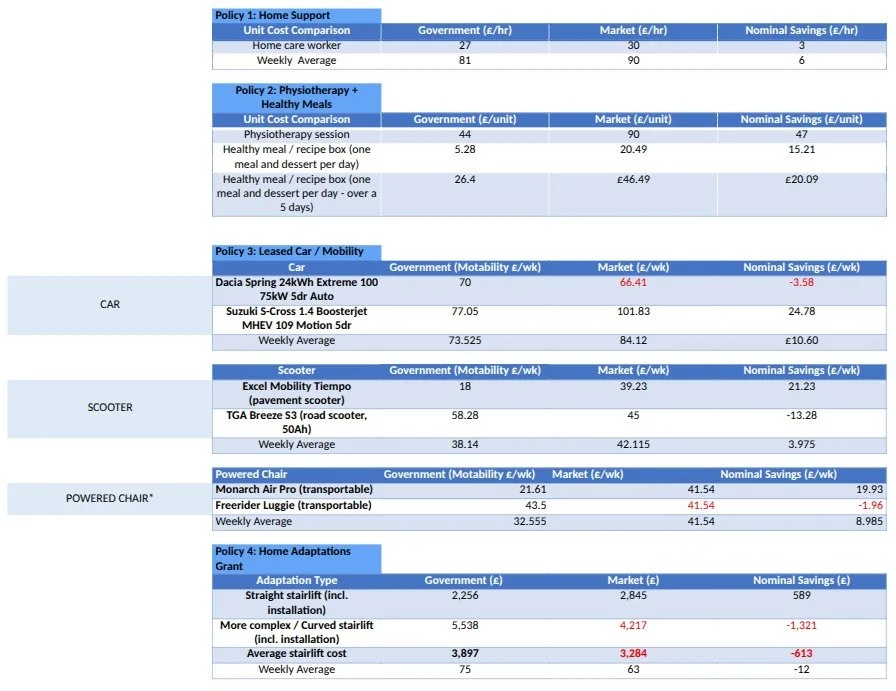
The state's role as a bulk buyer is essential to ensuring this new model is cost-efficient, both for user and state alike, whilst also providing high-quality services without compromise. By transitioning from fragmented private provision to coordinated public procurement, the government can leverage its immense purchasing power to deliver high-quality services at a substantially lower unit cost than individual claimants could ever achieve alone. As we note in the appendix, unit costs for services listed are significantly lesser than their market rate.
The efficiency of state procurement
6.1
Analysis of the proposed Menu of Options reveals a significant efficiency gap between public and private service delivery. For the 3.4 million individuals estimated to take up at least one service, the annual cost of coordinated public provision is estimated at £6.58 billion—an expenditure that can definitely be delivered within the current Treasury spending envelope. Crucially, if these same individuals were to seek these identical services through the private market, the cost would rise to £9.79 billion annually.
This represents a £3.21 billion annual saving achieved solely through the state's role as a strategic buyer. This efficiency also holds on a unit-by-unit basis, where most services can be procured below market value.
However, the overall level and structure of service provision can be flexibly altered to adjust the cost profile. Across the entire menu, delivery parameters can be adapted - for instance, providing therapy via group sessions rather than individual consultations, shifting from in-person to online delivery, or moving from weekly to fortnightly schedules.
By utilising the Department for Work and Pensions' (DWP) scale to negotiate directly with providers and employing direct-to-supplier payments, the system eliminates the administrative middle man and ensures every pound of welfare spending goes further. The fiscal logic of this model is built on the reallocation of existing benefit expenditure, so that it sits within the current budget. With disability benefit spending projected at approximately £70 billion in 2024–25, the £6.58 billion required for the service menu is not an additional cost but a strategic redirection of funds already committed to claimants.
The state's capacity to save is driven by the volume of claimants willing to exchange their cash awards - currently set at weekly rates such as £72.65 for standard daily living and £75.75 for enhanced mobility - for these government-negotiated services:
Willingness to exchange: Almost one in three claimants (31%) is willing to exchange at least £50 per week for services, while one in five (19%) would exchange £100 or more—led by home support (20% at £50+), physiotherapy (19%), and home adaptations (18%).
The optimal range: Research identifies the £50–£100 per week band as the optimal exchange range for scheme design. This mirrors the successful Motability model, where up to 890,000 claimants currently exchange their £75.75 mobility component for a leased vehicle.
[1] See appendix for methodology.
Supporting re-entry into the workforce where applicable
6.2
The most profound savings for the state lie in the potential to move able-to-work individuals off benefits entirely by removing the specific barriers to work. In time, we could therefore find indirect savings where the money used for certain services end up being a cost saving for the Government if the individuals using them fully re-enter the workforce.[4]
Among claimants who could work, there is a striking appetite for vocational services that is far higher than the general claimant average. Even among those already working, nearly half (47%) want to increase their income but say health currently prevents it, 37% could with the right flexibility or support, and 18% want additional skills or training to get there. Half (49%) of could-work claimants say working would improve their confidence and wellbeing, and a third (32%) say a voluntary route into support would make them more likely to look for work:
Vocational demand: Across all claimants, interest in training rises from 15% to 18% among those capable of returning to work, therapy from 14% to 18%, and among claimants already in work, training reaches 38% and therapy 37%.
Youth engagement: Among 16-34 year old claimants, demand is higher still, with 30% seeking training and 25% wanting job coaching.
Removing the right barriers: The services claimants say would help them work map directly onto the menu - 38% of in-work or could-work claimants want skills to manage their condition while working, 29% want support with confidence and motivation, and 12% of out-of-work claimants left work because they could not access the treatment or therapy they needed.
By acting as an intelligent customer, the state does more than just save on the unit cost of a physiotherapy session or home adaptation. It uses the existing welfare budget to invest in the autonomy of the individual, providing the tools necessary for claimants to transition from benefit dependency to employment, ultimately reducing the long-term fiscal pressure on the Exchequer.
[4] Though GGF would argue for a phased-out scheme where services remain accessible early into new employment.
Bulk buying in practice: Lessons from elsewhere
6.3
The successful delivery of the Menu of Options model depends not only on the existence of choice but on the consistent quality and reliability of the services provided. To ensure that claimants - especially the most vulnerable - receive high-quality care that truly facilitates autonomy, the government must be reliably realised.
By utilising strategic procurement and bulk purchasing, the state can leverage its significant market power to guarantee standards that individual claimants, acting alone in a complex private market, may not be able to secure within their means. This provides both efficiency and quality control. Much like the Motability scheme, the Government can use its negotiating power to set high baseline standards for contracted providers.
Lessons from the Australian Model
Australia's 'Bulk Billing' system within their healthcare system provides a potential template for securing third party participation in such a scheme. Under the Bulk Billing Practice Investment Programme, GP services - private, atomised services under the Australian healthcare system - receive financial incentives to treat eligible patients without additional charges under the mixed system.[5] Since 2013, this has ensured that over 70% of consultations are bulk-billed, maintaining high levels of accessibility.[6] For our proposal, this demonstrates how these otherwise atomised parties can be integrated into a no cost, state-procured system to provide a service. Further, Australia's Pharmaceutical Benefits Scheme (PBS) highlights the power of the state as a sole buyer to mandate price reductions for prescriptions as well.
Global evidence of procurement efficiency
International precedents further support the move toward centralised or pooled purchasing to drive up service standards. Research into health procurement in Scotland, the EU and as far as Jordan and the Caribbean confirms that when the state acts as a single, large-scale purchaser, it achieves significantly better supply consistency than fragmented regional buyers.[7] Domestically, the Welsh government's collaborative procurement of electric vehicles demonstrated that pooled demand not only creates savings but also reduces lead times, ensuring that users receive essential equipment faster - one of the key objectives of our proposed model.
In the context of the Menu of Options, this means the state can ensure that high-demand services - such as home adaptations or specialized equipment - are available and delivered promptly, avoiding the delays often found in the private retail market.
Performance-linked provision in the EU
Beyond simple purchasing, procurement can be used to mandate social outcomes. Evidence from EU procurement, specifically Social Impact Bond (SIB) services in Finland, shows how linking provider payments to performance risk can improve service delivery.[8] In the Finnish model, the project manager's payments were determined by the number of participants successfully moved off (applicable) benefits and into employment compared to a control group. This resulted in a 50% employment rate among participants, significantly outperforming traditional methods.[9] By adopting similar outcome-based contracts, the DWP can ensure that vocational and mental health providers on the Menu are held accountable for the actual improvements they facilitate in claimants' lives.
Ensuring accountability and trust (and what not to do)
To ensure these procured services meet the actual needs of disabled people, the system must incorporate systematic follow-up. Research from Sweden regarding municipality-led service delivery serves as a cautionary tale; it found that a lack of structured evaluation often led to inconsistent quality and a failure to meet long-term goals.[10] Therefore, the delivery of our pilot scheme must be co-designed with DPOs to overcome the fear and skepticism often associated with state intermediaries such as Job Centres. That scepticism is well-founded in claimants' experience: six in ten (60%) have never engaged with any government employment support scheme. By prioritising providers that are trusted by the community and implementing rigorous performance monitoring, the Government can transform the ‘Menu of Options’ into a high-quality, reliable framework that supports long-term independence and a successful return to the workforce.
The case of Scottish co-implementation
The key to successful implementation is ensuring that DPOs are involved in design but also, where possible, implementation. Our proposals can learn from Scotland's recent shift in how it handles disability benefits. In 2022, Scotland replaced the UK-wide Personal Independence Payment (PIP) with its own version, called the Adult Disability Payment (ADP). While the money is similar, the way it is delivered is very different. Scotland treats DPOs as equal partners in providing services, rather than just asking for their advice. For example, Scotland funds a free Independent Advocacy Service run by a charity called VoiceAbility. This service is completely separate from the government; it provides a professional advocate to sit with a claimant, help them understand the forms, and make sure their voice is heard during the application process.
Further, Scotland used 'Experience Panels' of thousands of disabled people to design the ADP from the ground up. This led to a system that is more person-centric; for instance, they removed the stressful, high-stakes physical assessments used in the rest of the UK and replaced them with a model that trusts the claimant's own account of their life. By using DPOs to bridge the gap between the government and the public for certain service provision, Scotland has created a guardrail that protects individual choice. To make our proposal successful and keep it strictly voluntary, the government should look to involve these types of user-led organisations in delivering and especially checking the quality of services provided as part of any menu of options wherever possible.
[5] Australian Institute of Health and Welfare, ‘Medicare bulk billing and out-of-pocket costs of GP attendances over time’, p 6, December 2024.
[6] Australian Institute of Health and Welfare, ‘Medicare bulk billing and out-of-pocket costs of GP attendances over time’, p 6, December 2024.
[7] World Health Organisation, ‘Challenges and opportunities in improving access to medicines through efficient public procurement in the WHO European Region’, p 14, June 2016.
[8] European Investment Advisory Hub, ‘Case Study: Children’s Welfare SIB, Finland’, p 4, July 2021.
[9] University of Oxford Government Outcomes Lab, ‘Kotouttamisen (KOTO) Social Impact Bond’, January 2022.
[10] Andreas Bergh, ‘Municipally owned corporations in Sweden: A cautionary tale’, p 588, October 2023.
Next Steps for a Pilot Scheme
To transition from theory to practice, we propose a targeted pilot scheme. This pilot would focus on the £50-£100 per week exchange range identified in our research as the optimal band for participant engagement and service viability.
The delivery of this pilot - the who and where - should be co-designed with DPOs, who also tell us there is significant fear and scepticism surrounding Job Centres and job coaches, and thus the intermediary that provides and offers these services should be a point of discussion to ensure full faith in the system. Our polling underlines the point: only 16% of claimants have engaged with Jobcentre Plus work-focused support, and a voluntary route outside that setting is precisely what the job coaching option offers. The eligibility for a provider to take part should be dictated by tight quality control and eligibility criteria co-designed with these DPOs.
This approach itself, however, is grounded in successful international and domestic precedents that demonstrate the power of personalised budgets and can offer a vision for successful implementation. In Australia, the National Disability Insurance Scheme (NDIS) represents a global gold standard in choice and control, moving away from block funding to a model where individuals have personal budgets to purchase specific therapies or equipment. Similarly, in the UK, NHS Personal Health Budget pilots proved that when patients choose their own care, health outcomes and satisfaction levels rise significantly. This proposal simply expands the proven logic of the Motability model - where up to 890,000 people already swap cash for a service - to a wider menu of options learnt from existing models.
Moving forward, we will engage with government departments to demonstrate that a non-cash service model is both popular and cost-effective.


Part 6
Conclusion
A better way forward for all
The welfare system is currently punishing, confusing and met with scepticism from all sides. The resulting discourse has since become deeply unproductive, hardwired to look at numbers rather than people. This ultimately offers only paternalism, not autonomy. Claimants are clear about this: 63% say the system needs change to work better for people like them, and half want it to aim for more than keeping people out of hardship - independence, skills and the ability to contribute.
A system that offers a new ‘Menu of Options’, entirely voluntarily, that is drawn up with those that would benefit in mind, presents a more thoughtful way forward that also leans on the state as an effective negotiating power.
If the aim is not to cut costs, but to present stronger solutions for those affected, it may be that the cost question is addressed regardless. But the aim of any welfare system must first hold the person at its core. We believe this proposal does just that. It builds on domestic and international precedent, and - most importantly - it has the backing of the communities it serves.
With special thanks …
With gratitude to the DPOs and charities we spoke with across this project, especially the Disability Benefits Consortium and their members.

Methodology
Costings
This report includes an analysis of the potential demand and fiscal impact of a disability service package determined by the below methodology. The proposed services analysed include training, therapy, home support, job coaching, and mobility assistance. We have had to include various assumptions noted below.
Executive Summary
1
Total Government Cost: Estimated at £6.58 billion annually.
Private Market Comparison: Equivalent private access for the same level of participation is estimated at £9.79 billion annually.
Fiscal Efficiency: Coordinated public provision saves approximately £3.21 billion compared to fragmented private market access.
Total Uptake: Approximately 3.4 million individuals are expected to participate in at least one service.
Fiscal Context: This represents a material addition but is significantly smaller than the ~£70 billion current disability benefit expenditure.
Methodology
2
Eligible Population (N)
The model uses administrative data from August 2025 to determine the total eligible population.
Working-Age Population (N_WA): Includes recipients of PIP/DLA, Incapacity-related benefits (INCAP), and the Universal Credit (UC) health journey.
Universal Credit Health Calculation: Derived by summing individuals in Pre-WCA, LCW, and LCWRA categories.
Formula: N_UCHealth = N_pre-WCA + N_LCW + N_LCWRA
State Pension Age (N_SPA): Includes PIP, DLA, or Attendance Allowance (AA) recipients.
Total Population (N): Aggregated to ensure no double-counting.
Formula: N = N_WA + N_SPA
Prices and Unit Costs
Nominal values are uprated to 2026 price terms using an ONS CPI index.
Formula: Cost_2026 = Cost_t * (CPI_2026 / CPI_t)
The model assumes fiscal neutrality at the point of provision, meaning the exchange price (p) equals the unit cost of provision.
Formula: p = c
Demand and Participation
Demand is derived from survey-based Marginal Willingness-to-Pay (WTP).
Participation Rate (pi): The model assumes a single-choice constraint, where individuals select at most one service to avoid overstating demand.
Formula: pi = Probability that (Max WTP - Price) >= 0Total Uptake:
Formula: 3.4 million = pi * N
Allocation Across Service
A proportional allocation approach is used to distribute demand across services.
Service Share (s):
The share of total demand for a specific service.
Formula: s_j = (Demand for service j) / (Sum of demand for all services)Final Service Uptake (Q):
Formula: Q_j = pi N s_j
Aggregate cost estimation
3
The Total Annual Government Cost (TC) is the sum of unit costs multiplied by uptake for each service.
Formula: TC = Sum of (Unit Cost * Service Uptake)
The Private Market Cost (TC_priv) uses alternative private-sector unit costs for the same level of participation.
Formula: TC_priv = Sum of (Private Unit Cost * Service Uptake)
Findings
4
Service Distinction: High-volume, lower-cost services drive participation, while lower-volume, higher-cost services drive total expenditure.
Policy Credibility: Coordinated delivery achieves lower effective costs than fragmented private provision, making it a credible complement to cash benefits.
Full unit costings
5