

August 2026
A Watertight Solution for Public Control
"Privatisation was a massive mistake, but nationalisation costs too much."
- Woman, Labour-Reform Switcher
Foreword
Helena Dollimore
MP for Hastings, Rye and the Villages
The water industry is fundamentally broken. Our failing water infrastructure is a huge problem that must be a top priority for our Labour Government. As I know from my constituents in Hastings & Rye, nothing enrages voters more than watching their bills skyrocket to prop up failing companies, while executives and shareholders try to find ways to evade bonus bans as companies edge toward bankruptcy. We have already taken important steps to ramp up regulation but we must now go further to protect this vital national infrastructure, while always being fiscally responsible.
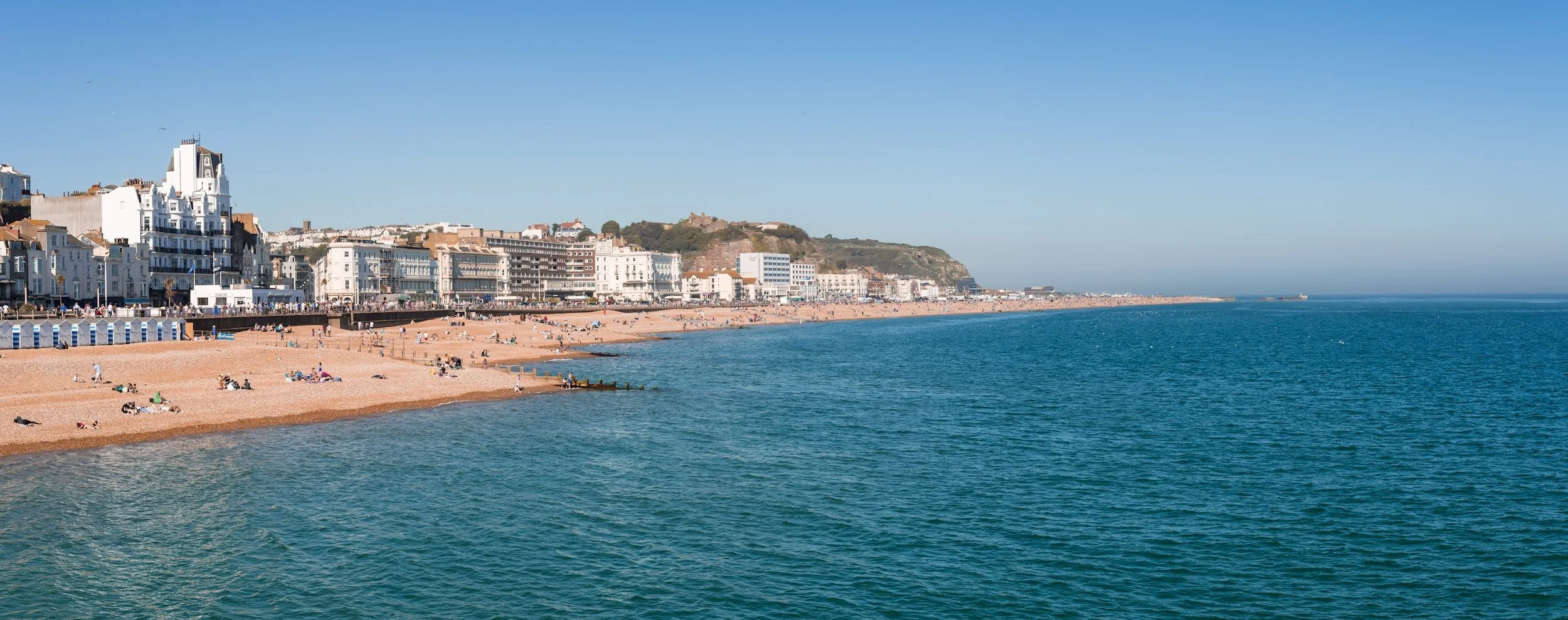
In the past five years alone, the people I represent in Hastings, Rye and the villages have endured two major water outages – one lasting five days, another nine. Hastings town centre suffered major flooding thanks to Southern Water and livelihoods were ruined. Sewage is dumped into our sea regularly, compromising public health and tarnishing our reputation as a tourist destination. Last year, 300 million plastic beads washed up on our beaches and after getting on our hands and knees to clear as many as we could, we uncovered that they had come from a Southern Water treatment plant, causing an environmental catastrophe. While the service keeps failing, our water bills keep rising. I know that people around the country face similar disasters, while water companies reap the profits.
That is why this report matters. With Thames Water on the brink, Andy Burnham's Labour Government has a golden opportunity to fix this injustice. As climate change threatens our water resilience more than ever before, and growth engines like AI data centres demand more water too, there has never been a more important time to fix this vital national infrastructure.
Moving the water industry to a cooperative model would be the radical shakeup the water industry desperately needs. The Government would be able to take our most precious resource back into public control, without asking taxpayers to bankroll City executives’ debt. Taking on the water industry would prove the Prime Minister is serious about dismantling the economic model of the past 40 years and showing voters we are up for a fight.
Helena Dollimore is the Labour and Cooperative MP for Hastings, Rye and the villages. As a member of the Environment Select Committee, she questioned water company executives. Before entering Parliament, Helena worked at Unilever, becoming one of the youngest directors in the company’s history.

“Greater public control of water companies is the only way to protect our communities and environment for future generations. The Good Growth Foundation have set out a radical set of proposals that would do just that. Now is the time for change.”
- Tracy Brabin, Mayor of West Yorkshire
Executive Summary
England's water settlement has become a symbol of state failure for millions of billpayers who face sky-high bills while sewage spills into their rivers and coastlines. But what is the solution when nationalisation comes with such an unfeasible price tag?
The answer is to bring water companies back under public control as not-for-profit cooperatives, without taxpayers picking up the bill.
Under a cooperative model, customers own and run the company. It is run for the benefit of the customers, not for profit. There are no shareholders, and therefore no dividends to fund, allowing reinvestment and a focus on customers and long-term performance, not short-term extraction and over-leveraged debt piles. The company remains off the government books.
PUBLIC CONTROL
New water cooperatives owned by customers
Democratic representation on the Board of Directors
Abolish Ofwat and restore Ministerial decision making
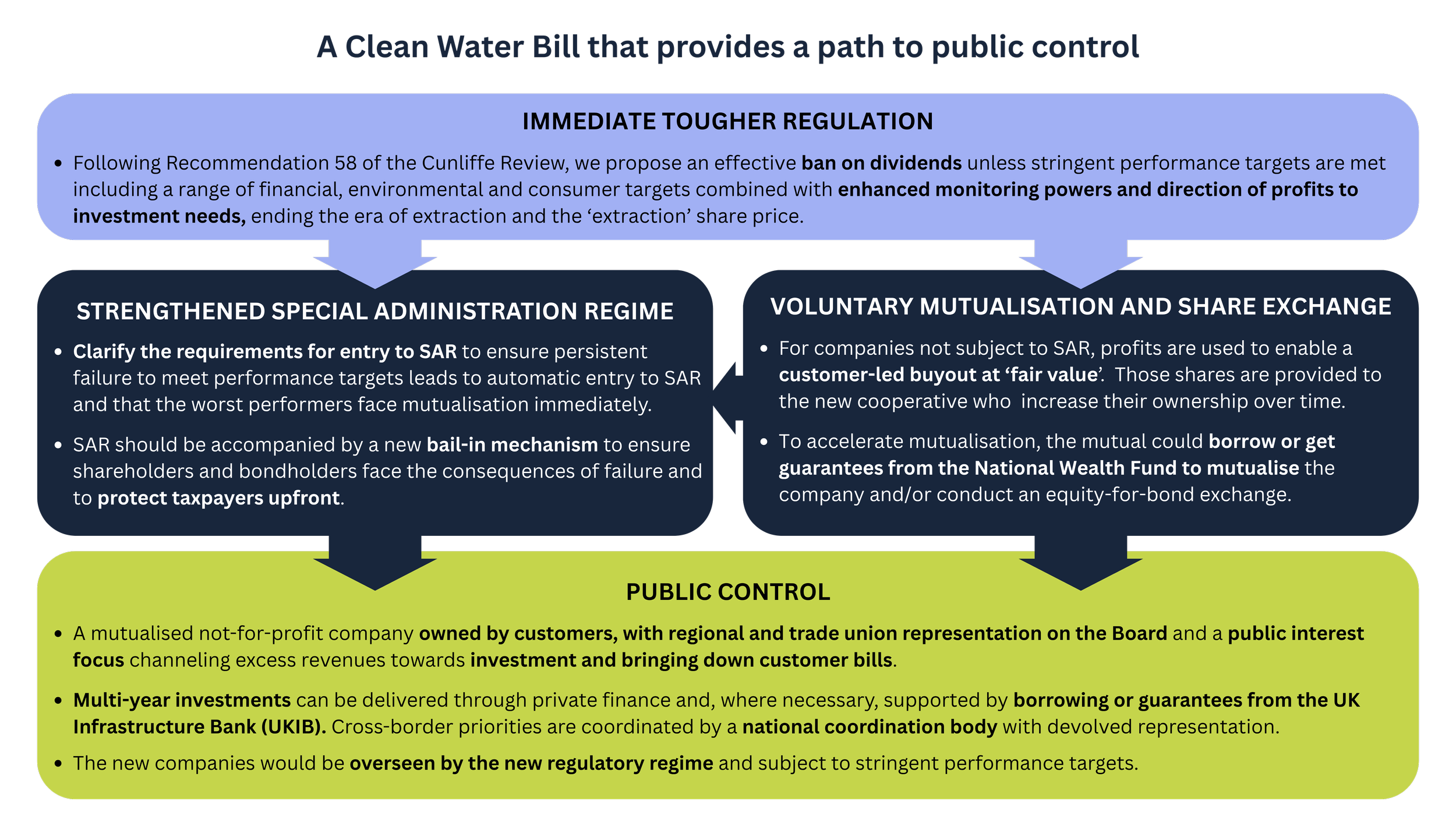
IMMEDIATE TOUGHER REGULATION
Ban dividends and prioritise investment
Government appointed observers in each company
Restrictions on bonuses and other remuneration
NO TAXPAYER COST
No debt on the Government balance sheet
An enhanced SAR mechanism with faster resolution of failing companies through bail-in as used in the financial sector to protect taxpayers up front
BETTER OUTCOMES
Lower bills in the long term
Better governance and regional representation
Improved credit ratings and lower debt interest
The crucial question is how to get there affordably and as quickly as possible. We propose a piece of primary legislation that does two things.
First: force the worst offenders into public control fast. Clarify and lower the bar for the Special Administration Regime, and ensure shareholders and creditors, not the taxpayer, pay the price of failure.
Second: deliver an ultimatum to the remaining shareholder-owned companies. Unless they meet fierce new financial, environmental, consumer and resilience obligations, dividends will be banned outright. Alongside tougher oversight and fines, the sector will also be provided a path to mutualisation. They can come the easy way, by selling up at a fair price and handing the company to its customers in a share exchange scheme. Or the hard way, via the lowered bar for an enhanced Special Administration Regime, where any failings will trigger a tougher settlement for shareholders and bondholders.
The John Lewis Partnership, the Co-Op and Nationwide demonstrate how the cooperative model works. It can deliver stronger governance, an enhanced credit rating, a lower trajectory for customer bills and better outcomes for the people it serves. Mutualisation redistributes power to the people and reconnects communities to the institutions that serve them. It will help deliver the Government’s manifesto commitment “to double the size of the UK’s co-operative and mutuals sector”.[1]
[1] The Labour Party, ‘Change: Labour Party Manifesto 2024’, 2024, p.35.

Part 1
A Failed System
“As soon as you’ve got people trying to maximise the dividends they can get out, or the bonus they can achieve at the end of a year - that’s when you see things like Thames Water not updating their pipes over 15, 20 years.”
Male, Labour-Green Switcher
For far too long, weak regulation and a weak regulator have enabled an era of extraction to be adopted by investors and water executives abusing their monopolist position. Prices have risen significantly, profits and dividends soared, while investment lagged, customer satisfaction declined and sewage destroyed our waterways.
Customers pay more… Residential water prices are 40% more expensive in real terms since privatisation,[2] and Ofwat has permitted a further 36% increase over the next 5 years.[3] The only mutualised company in the sector was able to reduce bills in real terms by 4% between 2000 and 2020.[4]
Debt balloons... Borrowing across all water companies totalled £82.7bn in March 2025, a 10% increase in a year, despite profits continuing to be extracted.[5]
Investment lags behind… The National Audit Office (NAO) found that “Defra and the water sector's regulators have not encouraged water companies to spend what they need to deliver the performance expected”,[6] and a large number of companies underspend their investment allowance while increasing bills.[7]
Infrastructure crumbles… three-quarters of water companies failed to meet their water supply interruption target in 2025 and more than half of them had worse performance in 2024-25 than 2019-20.[8]
Customers come last… Every water company has lower customer satisfaction levels in 2025 than in 2020, with most companies seeing falling satisfaction every year throughout that period.[9] Sewage dumping reached record levels in 2024 with 3.6 million hours of sewage dumped by water companies in England.[10]
Shareholders keep winning… Since privatisation, official figures from Ofwat show £54.9 billion in dividends declared by regulated water companies or £72.8bn in real terms.[11][12]
Case Study: The Failures of Yorkshire Water
Yorkshire Water has become symptomatic of the wider failures of the privatised water sector.
In December 2020, around 5,000 homes in north Leeds lost water or pressure after a large burst main in Alwoodley, which Yorkshire Water treated as an emergency.[13] In March 2024, a burst at the A63 roundabout in Garforth cut supply to homes, with part of the road surface crumbling from the damage.[14] In October 2024, a burst main near Bradford flooded onto the M62, closing the road.[15] In March 2026, two burst mains on the A660 near Bramhope severely damaged the road structure, forcing a full closure near Golden Acre Park with diversions stretching across north-west Leeds.[16]
In August 2022, Yorkshire Water issued a hosepipe ban on its five million customers, the first in 27 years. Reservoir levels fell below 50% for the first time since the 1995 drought, with one West Yorkshire reservoir only around 20% full;[17] Yorkshire was later placed into drought status by the Environment Agency.[18] Three years later, in July 2025, Yorkshire was again placed into drought status after a dry and warm spring left reservoirs at 55.8% capacity.[19]
The most severe single incident in Yorkshire Water's recent history took place during this drought status, when a water main burst in Stannington, flooding the local gas network with around 1.3 million litres of water.[20] Around 2,000 properties lost their gas supply, leaving households without heating, hot water and cooking facilities, with Sheffield City Council declaring a major incident.[21] The pipe that burst was later confirmed to have been an asbestos-cement main installed in 1970.[22]
“The people of West Yorkshire have paid the price for Yorkshire Water’s failings for far too long, with repeated pollution failings and hiking bills repeatedly during a cost of living crisis.
“Greater public control of water companies is the only way to protect our communities and environment for future generations.”
Tracy Brabin, Mayor of West Yorkshire
[2] Full Fact, ‘Water rip-off? Are water bills up 40% since privatisation?’, Nov 2018.
[3] Ofwat, ‘Ofwat approves £104bn upgrade to accelerate delivery of cleaner rivers and seas’, Dec 2024.
[4] Saïd Business School, University of Oxford, ‘Welsh Water: hasA Model for the Purposeful Ownership of a Utility?’, Jan 2021.
[5] Ofwat, ‘Monitoring Financial Resilience Report 2024-25’, 2025.
[6] National Audit Office, ‘Regulating for investment and outcomes in the water sector’, 2024.
[7] Financial Times, ‘Quarter of UK water groups underspend investment allowances as network creaks’, Jul 2026.
[8] Ofwat, ‘Water Company Performance Report 2024-25’, Oct 2025.
[9] Ofwat, ‘Water Company Performance Report 2024-25’, October 2025, pp.14-15.
[10] The Rivers Trust, ‘2024 Annual Sewage Spill Data’, 2025.
[11] Ofwat, ‘Returns and dividends’, accessed Jul 2026.
[12] BBC News, ‘Water industry investors have withdrawn billions, claims research’, May 2024.
[13]Yorkshire Evening Post, 'Around 5,000 homes left with no water or low pressure due to large burst in north Leeds', Dec 2020.
[14] BBC News, 'Garforth emergency road closure after burst water main causes flood', Mar 2024.
[15] Yorkshire Post, 'Burst water main causes flooding on M62 Bradford, road closures and delays', Oct 2024.
[16] Bramhope & Carlton Parish Council, 'Burst water main on Leeds Road – update', Mar 2026.
[17] BBC News, 'Yorkshire Water admits hosepipe ban could run into 2023', Sep 2022.
[18] Yorkshire Post, 'Drought officially declared in Yorkshire by the Environment Agency after extreme weather leads to dried up reservoirs and low river flows', Aug 2022.
[19] The Independent, 'First hosepipe ban of 2025 takes effect in drought-hit Yorkshire', Jul 2025.
[20] BBC News, 'Stannington: Gas restored to all homes after two-week supply cut', Dec 2022.
[21] BBC News, 'Stannington: Major incident declared as homes still without gas', 7 Dec 2022.
[22] BBC News, 'Stannington: Cause of flooded gas supply still unknown', 8 Dec 2022.

Part 2
Public Attitudes
“I don't have a problem with the government saying, look, we don't want to take on the cost of running it - but I don't think it should then be a for-profit company.”
Male, Labour-Green Switcher
While the public have accepted that privatisation has been a failure, they are also not willing to sign off on costly nationalisation. The only route through this impasse is for England’s privately owned water companies to be replaced by not-for-profit water mutuals, owned by the public through a cooperative model. Each mutual should be constituted as a company limited by guarantee with no shareholders, financed primarily through bond issuance and bound by a public benefit duty requiring it to act for customers, communities and the environment.
Customer ownership is the only water ownership model that is politically viable. Just 8% want water companies to stay in the hands of private shareholders, while 72% want an alternative model. Mutualisation is the outright first choice of Reform voters (35%, against 30% for state ownership), and runs level with the state among Greens (35% to 36%) and Conservatives (32% to 33%). But across every party, voters who back state ownership only do so if it costs little or nothing.
Among Labour's own voters, for instance, the state remains the first choice in principle, but only around a quarter say a state takeover would be worth it whatever the price, with most either making their support conditional on a low cost to taxpayers or rejecting a costly buyout outright, as the chart below shows.
In our focus groups, Labour to Reform switchers combined fury at the current model with hard scepticism that Westminster could afford, or should prioritise, a state takeover. Only around a quarter of Labour to Reform switchers (24%) say public ownership would be worth it whatever the cost, while a majority (55%) either make their support conditional on a low cost to taxpayers or reject it outright - broadly in line with the electorate as a whole. Labour to Green switchers are warmer to public control in principle, yet half (50%) still say it is only worth it if the cost is low or close to zero. This is precisely the gap mutualisation is built to close: public control without the price tag that voters will not accept.
Mutualisation would also directly advance the Government's manifesto commitment to "double the size of the UK's co-operative and mutuals sector."[23] Converting England's regional water monopolies into customer-owned mutuals would be among the single largest expansions of the cooperative economy available to ministers, turning a stated ambition into a flagship delivery.
[23] The Labour Party, ‘Change: Labour Party Manifesto 2024’, 2024, p.35


Part 3
Regulation that serves people, not vested interests
The Independent Water Commission’s 2025 review into the water sector also found that trust in the regulators and the regulatory regime has been eroded. The review, led by Sir Jon Cunliffe, found that “there is a need for a much stronger regulatory framework” and proposed the abolition of Ofwat, followed by the creation of a new regulator combining the powers of Ofwat, the Environment Agency and the Drinking Water Inspectorate.
The outsourcing of the state to unelected and unaccountable regulators is a wider problem facing the UK, and steps are already being taken to address this in other areas. While there are legitimate reasons for some economic regulatory decisions to be taken independently, too many policy decisions have been outsourced to regulators alongside this. In proposing tougher powers to tackle water companies, we believe that Ministers should take a far greater role in exercising those powers, restoring democratic control over those decisions.
A Tougher ‘Turnaround Regime’
3.1
Our proposal for a tougher regime reflects a recommendation made by the Cunliffe Independent Water Commission[24] that was not taken up in the Government’s White Paper. While the Independent Water Commission badged this tougher regulatory model as a ‘Turnaround Regime’[25] for companies failing in their duties, we consider that threshold is already met across the sector, with a significant increase in water pollution incidents (+27%) between 2019-20 and 2024-25 and with water supply interruptions and customer satisfaction deteriorating 8% and 9% respectively in the same periods. Given these failures, this ‘Turnaround Regime’ should become the baseline of regulation and is the only response that meets people’s expectations about how the water industry should be regulated following years of failure.
Independent Water Commission - Final Report
“Recommendation 58: A formal turnaround regime should be established for the regulator in England and Wales to support the turnaround of poorly performing companies. This should enable both an enhanced power of direction as well as regulatory forbearance.
Various restrictions on water company activity could be considered for inclusion in the turnaround regime, both to minimise further risks and to prevent moral hazard.
Cash-lock up. Ofwat already has the power to restrict dividend payments under specific circumstances. This power could be applied to a turnaround regime, to ensure funds are used for investment or retained to bolster resilience, and to ensure that the shareholders suffer consequences for entry into turnaround.
Bonus restrictions. For companies in turnaround, executive bonuses could be blocked or deferred until the company has met prescribed thresholds.
Direction. As part of Ofwat’s enforcement function, it accepts undertakings proposed by operators where it considers these will lead to compliance. Ofwat cannot currently propose the content of undertakings. With appropriate caveats, reforms could enable the regulator to direct that any penalty money taken from a water company’s profits is spent in a particular way to redress harm or to meet priority investment needs. In this way, the regulator could choose, for example, to direct that money which may have been spent on penalties is spent on improvements to infrastructure.
Capital structure. For companies in turnaround, the regulator should be able to direct them to inject new equity into the company where required. Failure to do so could trigger entry into the SAR. This may be facilitated by a new power with respect to company owners, as set out earlier in this chapter.
Enhanced monitoring. Ofwat already has the power to appoint an independent monitor to sit within and observe a water company’s corporate decision-making structure and provide enhanced information. This should continue and be applied to companies in turnaround.”
We echo the proposal from the Independent Water Commission that the regulatory regime should include a stronger ‘cash-lock up’ power to restrict dividends. We therefore recommend an outright ban on dividends by regulated water companies and their subsidiaries unless they meet stretching environmental, financial and consumer targets. The current threshold for banning dividends - primarily to protect financial resilience - is too weak and recent attempts to incorporate wider company performance puts the judgment of whether a company’s performance has been satisfactory enough in the hands of the Board of Directors, where incentives are misaligned [26].
A ban on dividends has previously been used temporarily by the European Central Bank and UK financial services regulators during COVID and was proposed recently in an Executive Order by President Trump for defence contractors that were underperforming [27]. Preventing dividends in the event of performance failures will ensure that profits flow to where they are needed, back into investment in infrastructure or improving financial resilience. As recommended by Cunliffe, powers should also enable the direction of those profits towards the most pressing investment needs. Any such ban on dividends should have immediate effect and legislation to implement it should be retrospective to the date of announcement, with a clawback mechanism, to prevent a dividend ‘gold rush’ in the interim.
The regulatory regime should also place all companies under Cunliffe’s enhanced monitoring regime [28]. Provisions for this already exist, but the powers are only used in cases of financial distress; this needs to change. The regulatory framework should allow the government to appoint individuals to monitor and observe each water companies’ corporate decision-making structures and require them to provide enhanced information to avoid the existing asymmetric information issues.
Combined with recent action to ban bonuses being paid to underperforming senior executives, these measures will ensure all stakeholders - executives and investors - are focused on performance. However, we have seen water companies adapting their remuneration to circumvent any bans [29]. We therefore propose that powers should be widened to ensure all aspects of the remuneration packages of senior executives are captured by the bonus ban.
[24] Independent Water Commission (Sir Jon Cunliffe), ‘Final Report’, 21 July 2025, Recommendation 58.
[25] Independent Water Commission, ‘Final Report’, 21 July 2025 (Ibid.)
[26] Ofwat, ‘Ofwat announces new regulatory controls on water company dividends’, Mar 2023.
[27] European Central Bank, ‘Recommendation ECB/2020/19’, 27 March 2020; Prudential Regulation Authority, ‘Statement on bank dividends’, 31 March 2020; The White House, ‘Prioritizing the Warfighter in Defense Contracting’ (Executive Order), 7 January 2026.
[28] Independent Water Commission, ‘Final Report’, Jul 2025, p.344.
[29] The Times, ‘Water boss denied bonus is granted £435,000 ‘allowance’ by company’, Jun 2026.
Performance Requirements
3.2
An immediate ban on dividends unless strict performance criteria are met creates new incentives for shareholders. Shareholders are motivated to direct investment towards urgent needs to avoid the dividend ban before mutualisation (see sections below).
Existing performance requirements originate from statutory requirements (e.g. in the Water Industry Act, Water Resources Act 1991, and Environment Act 2021), license conditions (e.g. PR24) and non-statutory conditions (e.g. guidance). These requirements and obligations have been created over time by a range of public bodies, including Defra, Ofwat, the Environment Agency and the Drinking Water Inspectorate, and the Independent Water Commission identified “gaps, misalignment, and inconsistencies between statutory and non-statutory targets”. There is therefore a strong case for rationalisation of the existing performance requirements, echoing Recommendation 8 of the Independent Water Commission’s final report.
Together with the toughening of regulation, banning of dividends and direction of profits, this places high expectations on water companies. This will force companies to retain profits for investment in the public interest and to improve performance. If they fail to meet them, they will face the enhanced Special Administration Regime, or if they do not like these new terms of trade, investors can sell up at a fairer price that puts an end to extraction as outlined in the following sections.

Part 4
The Transition to Public Control
Water companies can either come on this journey to mutualisation the easy way or, for the worst offenders, the hard way. A voluntary and market-friendly route should be provided that gives time and space to transition companies to a cooperative for those that remain compliant with environmental and wider obligations. For those that fail, it can be mandated through a far tougher Special Administration Regime (SAR) that is built to protect taxpayers and deliver mutualisation quickly.
Strengthened Special Administration Regime
4.1
The government states there is a “high bar” for use of SAR.[30] It is obvious from recent debates over whether to place Thames Water into SAR that the current high bar generates a fear of legal uncertainty about its use and whether any use will be challenged. This is combined with a fear of taxpayers ending up on the hook for companies’ debts and ongoing costs while a High Court appointee takes months to unravel the business, deliver an outcome for creditors and sell the business on. This has led to a stalemate where failing companies are stuck in limbo, too big to fail but also too big a failure to risk placing in SAR.
While existing shareholders in Thames Water have written down their stakes and accepted their fate, the same is not true for debt holders who are positioning to use SAR as a route to ownership and double down on the failed model of excessive debt.[31] The stalemate has gone on for many years, as Thames Water limps on and uncertainty looms over workers who face concerns about pensions and job security, and customers face uncertainty over bills and lack of investment in creaking infrastructure.
[30] Defra, ‘Committee Fact Sheet: Special Administration Regime’, 2025.
[32] The Guardian, ‘Thames Water’s biggest investor cuts value of its stake to zero’, May 2024.
A clearer entry point
4.2
To address the legal and financial challenges of the existing SAR, it should be reformed. Firstly, it should be clear what the bar for entry into the SAR is and it should be Ministers and appropriate regulators that manage both the activation and process of the SAR, not the High Court and High Court-appointed representatives.
The Water Industry Act 1991 - Special Administration Regime (SAR)[32]
The current SAR is underpinned by Sections 23-25 of the Water Industry Act 1991. The current process includes:
An application to the High Court by the Secretary of State or Ofwat on the grounds that:
“there has been, is or is likely to be such a contravention by the company of any principal duty … as is serious enough to make it inappropriate for the company to continue to hold its appointment”
“that there has been, is or is likely to be such a contravention by the company of the provisions of any enforcement order as is serious enough to make it inappropriate for the company to continue to hold its appointment”
action taken by the company has caused a contravention by a water undertaker/sewerage company of any principal duty”
“that the company is or is likely to be unable to pay its debts”
Once approved, the High Court appoints a Special Administrator. Once appointed, the Special Administrator must achieve the objectives of the Order while protecting the interests of creditors:
“during the period for which the order is in force, the affairs, business and property of the company shall be managed by a person appointed by the High Court-
for the achievement of the purposes of such an order; and
in a manner which protects the respective interests of the members and creditors of the company.”
The objectives of the Order are to ensure the continuation of the company as a going concern:
“the transfer to another company … as a going concern … in order to ensure that the functions which have been vested in the company by virtue of its appointment may be properly carried out; and
the carrying out of those functions pending the making of the transfer and the vesting of those functions in the other company or companies.”
Given the legal uncertainty about whether there is “likely” to be a contravention, whether a contravention is “serious enough” for the company’s ongoing license to be considered “inappropriate”, or whether a company is “likely to be unable to pay its debts”, further clarity is needed about when the SAR should be activated.
This should include specific measures which would trigger a SAR. We have used the indicators below to illustrate a range of possible performance targets which could be included in a reformed SAR:
persistent failures for 3 years on 50% or more of the targets set by the regulator
persistent failures for 3 years or more on any one of the following specific targets relating to:
pollution incidents;
environmental permits; or
infrastructure investment.
at least two ratings agencies classifying company bonds as junk grade (e.g. at or below Caa1).
If all three of these illustrative targets were adopted in combination, 7 of England’s 15 water companies would fail the tests and could be placed into SAR. These illustrative targets could be made more or less stringent.
Figure: Performance of English Water Companies against Ofwat targets and GGF hypothetical tests.[33]
[32] Legislation.gov.uk ‘Water Industry Act 1991: special administration’, accessed 21 jul 2026.
[33] Ofwat Performance Reports 2022/23, 2023/24 and 2024/25.
A new bail-in mechanism
4.3
Secondly, we should ensure the SAR can take a tough and fast approach to shareholders and company debt and protect the taxpayer. Currently, the responsibilities of the SAR fall to a High Court appointee after an application by the Secretary of State. The process takes months, if not years, and in the meantime, costs are borne by the Government, with debt and borrowing metrics impacted. Additionally, Defra says that the “Special Administrator does not include a power to ‘cancel debt’” and that “such a power would be a material departure from long established insolvency principles” [34]. The current regime, therefore, continues the principles of the Insolvency Act that prioritises protection for creditors’ claims on assets.
The government has established a ‘shortfall recovery mechanism’ in the Water (Special Measures) Act 2025, to support the recovery of taxpayer funds after a SAR. In order to protect the taxpayer, we propose that the SAR should replicate aspects of the Bank of England’s bail-in mechanism. This mechanism adopted new principles for the insolvency of banks to ensure that shareholders and creditors of failed firms are fully exposed to losses, and to protect the taxpayer from any exposure at the outset. These powers have been replicated in other jurisdictions, such as the EU, and used in the resolution of banks to quickly separate out and sell the underlying business as a going concern. The bail-in regime created a bespoke and quick insolvency regime managed by regulators, rather than the courts, to protect taxpayers and depositors from the failures of financial institutions and deliver a final resolution over a weekend, not over months. We consider that a similar regime is required for protecting the public interest in the water sector.
The regulatory framework should therefore have equivalent powers to impose losses on shareholders and haircuts on creditors to fully protect taxpayers, customers and workers upfront, and these powers should be in the hands of Ministers and appropriate regulators, rather than on application to the High Court.
Alongside protecting taxpayers from ongoing costs, the SAR should also prioritise the protection of workers’ jobs and pensions, in particular ensuring that workers are no worse off in respect of accrued pension entitlements as a consequence of a company entering SAR.
This could come from a combination of the Pension Protection Fund, commitments from the new mutualised company and further bail in of creditors where necessary.
The regulator should also have the ability to override any ‘change-of-control’ clauses in existing company debt to ensure the sustainability of debt in the new cooperative.
Finally, there should be a legislative requirement or expectation for the successor company that emerges from the SAR to be a not-for-profit cooperative, with a statutory duty in the licences of new cooperatives to protect public and environmental health.
Collectively, this puts the SAR on a stronger footing, providing clearer routes to access it, ensuring democratic control of it and giving it the most effective tools for protecting taxpayers and workers during a quick transition to sustainable public control. These reforms should be delivered quickly and ahead of any company using the current SAR framework, so that the full extent of the powers can be used quickly and ahead of the triggering of any ‘change of control’ clauses, to ensure companies return to public hands through mutualisation.[35][36]
[34] Defra, ‘Committee Fact Sheet: Special Administration Regime’, 2025.
[35] Defra, ‘A New Vision for Water’ (White Paper), Jan 2026, p.21.
[36] Ofwat, ‘Change of Control – General Policy’, May 2018.
Voluntary Mutualisation
4.4
For those companies that do meet regulatory requirements and therefore do not qualify to be put into the SAR, an alternative path to the cooperative model should be provided, backed by legislation to enable mutualisation over time. Where investors seek a way out, a range of market-friendly options could be provided to support the move to a mutualised company at a fair valuation.
We are proposing a new voluntary share exchange scheme. Given that dividends will be effectively banned, profits could be used to buy shares from those who wish to sell their stake and exit the business. Those shares will then be handed to a new mutual company - not abolished as in share buyback schemes, which keep share prices inflated - enabling the cooperative to increase its control and effectively mutualise itself over time. This option enables the cooperative to avoid taking on debt to cover the full value of the company.
If the cooperative or the government wished to accelerate the transition and acquire shares rather than wait for profits to be used in the share exchange scheme, it should also have the option of borrowing or seeking guarantees from the National Wealth Fund to increase its shareholding, or to convert existing shareholders into bondholders. A mixed approach could be taken between all three of these options.
Company Valuations: Defra has estimated the cost of nationalising the water industry to be in the region of £100 billion, using the sector’s Regulatory Capital Value (RCV).[37] However, the RCV paints a very different picture compared to other metrics of the company value.
[37] Defra, ‘Nationalising the water sector: how we assessed the cost’, Sep 2025.
Impact on investor sentiment
4.4
Our proposals give investors and bondholders a way out that reflects the fair value of the company, the performance of the company and the reality of the situation of these highly indebted and over-leveraged companies. It also aims to provide much greater transparency and certainty about the use of the SAR mechanism going forward.
In many cases, shareholders have already recognised that the failures in the sector have damaged their investments. As noted above, investors in Thames Water have already largely written off their investments in full or in part.[37] The Ontario Municipal Employees Retirement System (OMERS) has fully written off its 30%+ stake. The Universities Superannuation Scheme (USS) has significantly impaired its 20% stake, as have the Abu Dhabi Investment Authority (ADIA) and the British Columbia Investment Management Corporation (BCI).[38][39][40]
Despite writing down their stakes, each of these investors has continued to invest in the UK since the impairment, including in UK infrastructure:
OMERS has expanded investments in Oxford Properties' UK real estate portfolio, invested in Get Living - one of the UK's largest build-to-rent housing providers - and continued investments in UK life sciences and digital infrastructure assets.[41]
USS has invested up to £250 million alongside Blackstone in the proposed £10 billion hyperscale data centre campus at Blyth, Northumberland, one of Europe's largest planned AI and cloud computing facilities.[42]
ADIA invested in a new fund managed by London-based alternative investment manager Cheyne Capital.[43]
BCI made a significant £1bn BBGI, which is a significant owner of UK-based infrastructure assets.[44]
This demonstrates that despite their experiences with Thames Water, these investors continue to hold a positive view about the UK market. Our approach adopts existing market principles found elsewhere, including in the financial sector, that either provides shareholders and debt holders a fair market-led approach to exiting, or uses a SAR to push them towards mutualisation if they continue to underperform.
[37] Financial Times, ‘Thames Water’s biggest shareholder writes off investment’, May 2024.
[38] The Telegraph, ‘Thames Water is worthless, says biggest investor’, May 2024.
[39] The Guardian, ‘Thames Water’s second largest investor slashes value of its stake’, Jan 2024.
[40] VCCircle, ‘ADIA writes off 9.9% stake in struggling British utility Thames Water’, Oct 2024.
[41] Get Living, ‘Get Living opens DOOR to recapitalisation and targets 12,500 homes’, Jan 2023.
[42] UK Cities Investment, ‘USS backs Blackstone’s £10bn Northumberland data centre project’, May 2025.
[43] Reuters, ‘Cheyne Capital wins investment from Abu Dhabi’s ADIA for real estate debt fund’, Mar 2024.
[44] PwC, ‘PwC Corporate Finance advises BCI on acquisition of BBGI Global Infrastructure’, Jun 2025.

Part 5
The Benefits of Mutualisation
Mutualised water companies can focus on longer-term resilience using surpluses to increase reserves, service debt, improve capital maintenance, increase long-term infrastructure investment and provide a better focus on customers.
Mutualisation is not only an affordable alternative to nationalisation; it is also an ownership model that realigns owners, accountability and the long-term interests of billpayers. Where the shareholder model sets the interests of investors against those of customers, the cooperative makes them one and the same.
Three features make it the correct destination for the sector: better governance, a genuine long-term focus on customers, and public control without the fiscal consequences of a state buyout.
No taxpayer cost
5.1
Nationalising or the municipalisation of water companies would bring the industry onto the public balance sheet at significant cost to the taxpayer, as both the sector's assets and its very large debts would transfer to the government books, as well as the ongoing costs and investment requirements. Mutualisation offers an alternative for genuine public control, with the company remaining responsible for its own assets and debts. It is this distinction that keeps it off the government's books.
The line between a public body and a private entity is defined by the independent Office for National Statistics and based on internationally comparable norms. Broadly speaking, an entity is classified as part of the public sector where the government has the ability to determine its general corporate policy. The ONS assesses this against a number of indicators, including the right to appoint or remove a majority of the board, ownership of a majority of the voting interest, or special "golden-share" rights and a single decisive indicator can be enough[45]. The cooperative model does not cross these thresholds: even where a devolved body is able to nominate directors, so long as those appointments remain a clear minority that cannot determine general company policy, reclassification is avoided. Welsh Water is one example: a not-for-profit mutual that sits squarely in the private sector and off the government's books.
Mutualisation is uniquely suited to this political moment, answering the public’s call for reform while bypassing a costly buyout. It is the only solution which respects the majority of voters who do not want the government to cover the high cost of a buyout.
[45] Office for National Statistics, ‘UK economic statistics sector and transaction classifications: the classification process’, accessed 20 Jul 2026.
Better governance
5.2
Appointments & Membership Structure
Appointments and membership structures in the new mutual model should be designed to lock in independence while embedding clear lines of accountability to customers, communities and employees. Building on established cooperative practice, all eligible household and business customers in the region would become members of the mutual, exercising their right to elect their board through a ballot at an AGM.[46] Furthermore, building on the example set by the Co-Op group, a member council could be established, also elected at the AGM, which would oversee scrutiny of the board’s performance.[47]
The Role of Devolved Bodies
Local and combined authorities should be granted the explicit right to nominate a minority of directors to the mutual’s board, formalising a democratic link between elected representatives and the utility’s strategic decisions. These seats would give local government a voice over issues such as long‑term investment, resilience, and customer affordability, ensuring that local priorities are reflected in decision‑making.
To comply with ONS rules and keep the mutual off the government’s balance sheet, these locally nominated directors must remain clearly below the threshold at which government could determine general company policy. In practice, that means that where a company covers several local and combined authorities, the number of appointments must form a clear minority bloc on the board.
Under the new mutual regime, 50% of any financial penalties, not just performance-related fines, levied on water companies should be redirected to the communities that bear the consequences of failure. This ties enforcement to visible local benefit and reinforces the accountability of each mutual to the places it serves.
Trade Union Representation
Alongside local authority nominees, a defined proportion of board seats should be reserved for trade union representation, creating a structured “employee link” into the mutual’s governance. Union‑nominated directors would bring frontline experience on working conditions, safety, and operational realities into board deliberations, strengthening oversight of service quality and environmental performance.
These employee‑linked seats would sit within the same overall minority allocation that prevents any single interest group from controlling the board. The statutory framework should make clear that trade union representation is part of a broader model of stakeholder governance, combining community, workforce and customer interests without undermining the mutual’s non‑profit, customer‑owned character.
Defra’s Oversight - National Coordination and Oversight
We propose abolishing Ofwat, with Defra absorbing the vast majority of its responsibilities to restore democratic accountability of regulation and the setter of overall national water strategy. Defra ministers should have greater powers in setting the regulatory framework and expectations for water companies. Defra should act as the national coordinating authority for the mutual companies. This includes overseeing consumer protection standards, cross-border infrastructure investment, environmental and nature protections, maintaining governance expectations and setting the framework for affordability support across all mutuals. Furthermore, Defra is best placed to consider investment into longer-term strategic priorities such as resilience against cyber and foreign actors, future demand changes linked to national infrastructure and economic priorities and compliance with environmental regulations such as the Environment Act 2021.
[46] Nationwide, ‘Our Annual General Meeting’ accessed 20 Jul 2026.
[47] Co-operative Group Limited, ‘Rules of Co-operative Group Limited (the Society)’ Jun 2018, Pg 49.
Better outcomes: Ending extraction and focus on customers
5.3
Under the existing private ownership model, boards answer to shareholders whose motivations are extracting dividends. This has driven an exceptional rise in debt, financial engineering and dividend extraction that came at the expense of investment and billpayers.
For decades since privatisation, dividends have risen almost entirely in line with net debt, demonstrating how companies have used financial engineering and taken on debt simply to extract profits. A significant majority of the debt of the water companies could have been avoided if there had not been a need to pay dividends. This helps to demonstrate that the mutual companies should be not-for-profit companies with surpluses directed towards investment and reducing customer bills.
A not-for-profit cooperative removes this at source. Customers are the owners; there are no dividends and no incentives for financial engineering, because a bond-financed non-profit borrows to invest in assets rather than to manufacture shareholder returns. With no party seeking to maximise returns, the board's objectives shift onto what customers actually value: clean water, affordable bills and resilient networks. Regulation can police behaviour, but ownership determines motive and only a not-for-profit structure aligns the two permanently.
It also ends the culture of excessive executive pay. In a mutual, remuneration is set through the member structure and tied to service quality and public-interest outcomes rather than to share price, bringing to an end the pattern of large bonuses paid to executives even as companies continue to underperform and pollute.
Long-term focus on customer outcomes
Freed from the need to fund dividends, a mutual can reinvest its surpluses into what members prioritise: building reserves, servicing debt, maintaining and renewing capital, investing in infrastructure, and lowering bills. Crucially, previously neglected infrastructure investment can be prioritised, future-proofing the water system to be environmentally sustainable and structurally resilient. Its planning horizon is finally matched to the multi-decade horizon of the assets it manages, rather than to the reporting cycle of its investors.
As part of this, the government should set a framework for a common social tariff. The House of Lords Industry and Regulators Committee’s 2023 report called for a single social tariff, arguing that support for struggling customers should not depend on where they live.[48] The Independent Water Commission also recommended a single social tariff in England as part of its wider package to improve affordability and customer service.[49]
Financing
Mutualised companies can raise funds for investment from revenues or by raising debt. As the industry body Water UK notes, “debt is always cheaper than equity”[50] and so moving water companies to debt-only models, instead of relying on shareholders, does not result in higher financing costs. A cooperative means that there are no shareholders to extract dividends, so all profit is retained in the business. Mutuals can therefore achieve comparably stronger borrowing terms. As an example, Nationwide Building Society, the UK's largest mutual, holds a strong Moody's rating of A1 and an S&P rating of A+,[51] both higher than other shareholder-owned banks.
Within the water sector, the credit rating agency S&P, judged the operating model of Welsh Water as advantageous compared to its privatised peers. The lack of shareholder consideration required by executives enabled significant deleveraging while maintaining investment in infrastructure.[52] GGF's independent analysis concluded that non-mutuals in the water sector have historically had higher borrowing costs than mutuals. These lower borrowing costs mean real savings for the mutual, which can be passed on in the form of lower bills for consumers.
[48] House of Lords Industry and Regulators Committee, ‘The affluent and the effluent: cleaning up the failures of water and sewage regulation’, Mar 2023, p.32.
[49] Independent Water Commission (Sir Jon Cunliffe), ‘Final Report’, Jul 2025, p.7.
[50] Water UK, ‘myths & facts’, Oct 2024.
[51] BankCreditRatings, ‘Nationwide Building Society Credit Rating’, accessed 20 Jul 2026.
[52] S&P Global Ratings, ‘Dŵr Cymru (Financing) UK PLC’, RatingsDirect, Mar 2021.
Summary of Recommendations: A roadmap for converting private water companies into not-for-profit co-operatives
End the extraction of profits by banning dividends unless stringent and stretching performance targets are met alongside the use of enhanced oversight powers.
Clarify and lower the bar for entry to the Special Administration Regime (SAR) and create a new bail-in style mechanism for failing companies, in order to protect taxpayers and workers. Under our illustrative new bar for SAR, seven of the 15 English existing water companies would fall into the Special Administration Regime.
For companies meeting the strict performance targets, ensure profits are directed towards investment and provide pathways to mutualisation through a share exchange scheme, equity-for-debt exchange and loans or guarantees from the National Wealth Fund.
Abolish Ofwat and restore ministerial control over key regulatory decisions.
Enable devolved authorities and trade unions to nominate a minority of board members, ensuring democratic links and employee representation.
Create a common social tariff for water bills, set nationally by Ministers, so that support for struggling customers is consistent across England and Wales and does not depend on where they live.
Ensure that penalties levied on poorly performing companies are shared with the areas affected by distributing 50% of fines paid to the central government to local areas.
With special thanks to…
Jade Azim
Sasha Cattle
Billie Coulson
Tom Doherty
Louisa Dollimore
Kai Hain
Ruby Herbert
Ben McGowan
Max Mosley
Dylan Turner