


September 2026
Good Growth Budget
Freedom to choose, security to plan


Executive Summary
As the world around us fragments and other countries focus on homegrown economic growth and security, Britain has not yet fully woken up to the reality of new international trading habits and its place outside the EU. If Britain clings on to the economic model of previous decades as others shift away, it faces an extended period of passive decline with falling living standards and lower growth, leaving Britons feeling stuck in their everyday lives and further damaging trust in mainstream politics.
Half (51%) of all working age adults want to either move house, change job, retrain or have children and feel unable to. Three quarters (75%) of them are blocked by cost, and the problem compounds as one blocked life choice blocks another: nearly half (47%) of those held back from one of these choices are held back from another[1].
Restoring homegrown growth and delivering economic security for the country, regions and individuals alike will make Britain more resilient and enable people to make the big life choices like buying a home, having a child or taking time to upskill.
The upcoming Budget provides a key opportunity to begin the shift towards a new economic model, even within the current fiscal constraints. For individuals, this means supporting with the cost of living and reducing the cost of big life choices wherever possible. For our devolved authorities, this means providing new fiscal and regulatory powers to grow their local economies, restore their high streets, and attract talent. At a national level, this means ensuring government procurement, subsidies and reliefs are used in a way that prioritises national economic security.
[1] GGF Polling


Helping people with life choices and the cost of living
The cost of living crisis has made it increasingly difficult for people to make the big decisions that shape their lives. For too many people, choices that should represent opportunities – getting a job, moving into a home of their own, taking time out to retrain or upskill, or starting a family – are instead becoming harder to afford and harder to take. With household incomes limited, people’s ability to exercise choice and agency over their own futures is restrained. We must therefore give people greater security and greater freedom to make the choices that enable them to build careers, homes, families and better futures.
Key Policies
Reducing the upfront cost of buying a house by enabling people to pay their Stamp Duty bill through Income Tax by reducing their Personal Allowance.
Supporting people to buy a house or upskill by drawing down up to a year of their State Pension early and pushing back their State Pension Age by an equivalent amount.
Supporting graduates with the cost of Plan 2 student loans by restoring the real value of the repayment threshold and tackling avoidance by graduates who have gone overseas.
Buying a home, growing the family and upskilling
Stamp Duty delay and repay
Stamp duty is a high upfront cost that holds back the housing market and prevents people from moving and upsizing as their families grow. The upfront cost can eat into an initial deposit, limiting purchasing power and increasing borrowing costs by increasing the loan-to-value (LTV) ratio. To address this, we propose letting buyers reduce their Income Tax Personal Allowance to spread the cost of stamp duty over several years through the income tax system, rather than paying it upfront in full. In cash terms, an individual that reduces their income tax personal allowance in full by £12,570 would repay roughly £2,500 a year through higher income tax. Allowing an individual to reduce their personal allowance for a maximum of two years, would enable £5,028 of Stamp Duty to be paid more slowly through income tax, ensuring the average UK home purchase (c.£290,000) could be free of the upfront Stamp Duty payment (c.£4,500) altogether.
This would not be available to those who no longer have a personal allowance because of higher earnings. Any amount unpaid at the end of the two year period - possibly because of income falling below the normal personal allowance threshold - would be due within 14 days (as with the current Stamp Duty deadline).
In cash terms this is close to neutral, since it changes the timing of the tax rather than the total amount owed, though there may be a small ongoing cost to Public Sector Net Borrowing from delayed repayment. The total amount depends on demand for the delay and repay method, though a potential increase in transactions and increased purchasing power may somewhat reduce the overall cost.
State Pension Flexibilities to buy a home and upskill
The State Pension is worth around £12,500 per year to individuals when they reach the State Pension Age. Auto-enrolment into private pensions has improved the likelihood of younger people and lower earners having stronger levels of financial security in older age [2], reducing reliance on the State Pension in later life. This provides an opportunity for younger people to make trade-offs about their future retirement plans and to consider using their State Pension earlier to support the big economic decisions they may wish to make now.
We therefore propose that individuals should be able to voluntarily defer their State Pension age by up to two years in exchange for a limited range of benefits today to support them in making life choices. In particular, this should include the following options:
Moving home - Deferring the State Pension Age by up to one year to reduce a residential Stamp Duty payment by up to £8,500.
Upskilling or retraining - Deferring the State Pension Age by up to one year for up to £8,500 of support with the cost of a course with an accredited provider or maintenance, to enable more people to take time out of work to reskill without getting into debt or worrying about paying bills while studying.
Supporting with the cost of childcare -Deferring the State Pension Age by up to one year for up to £8,500 paid into a Tax Free Childcare account.
Anyone taking out these options will need at least 10 years of qualifying National Insurance Contributions - the equivalent for eligibility for the State Pension - ensuring that most people will be able to access these benefits by their 30s when they are likely to be making big life choices like buying a home [3], having children, or requiring retraining. Where the full benefit is not required, e.g. because a Stamp Duty payment is less than the maximum £10,000 allowed, the State Pension Age could be increased by less than a year proportionate to the amount required. Each flexibility could only be used once in a person’s lifetime.
The amount of £8,500 has been chosen to account for discounting, tax, borrowing costs, and mortality to make this option cost neutral in the long term. We also expect that the additional year of income tax receipts in later life would likely be higher than the tax receipts in the year the option is taken, when a person’s earnings are typically lower. However, due to the time difference in these payments they appear to ‘cost’ the Exchequer now, which we estimate to be around £1-1.3bn per year depending on demand, with the benefits not being realised until later when the State Pension Age is delayed.
Ending the unfairness of student loans
Restoring the real value of the Plan 2 repayment threshold
Over 5.4 million graduates who started university between 2012 and 2023 are repaying Plan 2 loans on terms that have repeatedly been worsened by threshold freezes and high interest. We propose a Graduate Guarantee: an immediate rise in the repayment threshold from £29,385 to £33,542, restoring the real value of the £25,000 threshold set in 2018. GGF polling shows that only half of Plan 2 loan holders who voted Labour in 2024 say they will stay with Labour and 38% of 16–18-year-olds say student debt makes them less likely to apply to university, rising to 45% among lower socioeconomic groups. Polling also highlights that the impact is felt more widely with 57% of the public at large saying the current system is unfair, with majorities agreeing across every party's voters.
We propose that the threshold would then rise each year with inflation, and that commitment would be enshrined in primary legislation so freezes can no longer be used as a fiscal lever. Graduates earning between the old and new thresholds would stop repaying. Everyone above the new threshold would save a flat £374 a year, so the benefit is proportionally largest for lower earners.
Recognising that this alone could cost up to £10bn as a one-off capital cost in the year of the change and recognising the fiscal constraints the government is facing, we have also outlined a range of smaller first steps the government could take to ease the cost of living for Plan 2 graduates and begin to regain their trust. Each of the increases below would give every graduate above the new threshold the same flat annual saving:
| Threshold increase | New threshold | Annual saving per graduate | Estimated cost | Share of full Guarantee cost |
|---|---|---|---|---|
| £882 (RPI uprating) | £30,267 | £79 | £2.12bn | 21% |
| £1,111 | £30,496 | £100 | £2.67bn | 27% |
| £1,389 | £30,774 | £125 | £3.34bn | 33% |
| £1,667 | £31,052 | £150 | £4.01bn | 40% |
| £4,157 (full Guarantee) | £33,542 | £374 | up to £10bn | 100% |
Tackling overseas evasion of student loan repayments
Alongside the recommendation to unfreeze the repayment thresholds for Plan 2 graduates, we recommend the Treasury and SLC act to close the overseas graduate loophole, which enables hundreds of millions of pounds in evasion.
As of April 2025, 286,000 borrowers in repayment lived overseas. Of these, 85,000 were EU nationals and 201,000 were UK nationals with an overall compliance rate sitting at 60.3% [4]. Non-compliance costs the taxpayer a reported £3bn [5]. The SLC does not generally lend to international students, however EU nationals were the exception until 2021/22 when settled/pre-settled status was required. The gap exists because once a borrower leaves the UK tax system, HMRC stops being involved and the SLC must rely on borrowers reporting their own income.
We recommend the SLC remains responsible for overseas collection, working with the relevant government departments and universities to enforce new penalties on borrowers deemed seriously non-compliant. New penalties are needed to encourage non-compliant borrowers to re-establish contact with the SLC and begin repaying. Borrowers who stay in contact but earn below their repayment threshold would be unaffected.

Good growth in every postcode
Delivering good growth in every postcode requires Whitehall letting go of the tools and funding for growth and handing them to local areas to use in the way that suits them. That starts with embracing regulatory and fiscal devolution to Mayoral Strategic Authorities (MSAs) and other levels of local government, so they can innovate, compete, and choose their own path to growth. This means boosting the existing Growth Deals, devolving more discretion on planning and environmental rules, establishing a toolkit for high street rejuvenation, and replacing Whitehall handouts with greater local control over income tax, council tax, and business rates.
Key Policies
Enabling Mayors to retain 5% of Income Tax receipts and 25% of business rates revenue in their area in place of the current Integrated Settlements
Developing a framework for Regionally Significant Infrastructure Projects providing a new route for Mayors to approve significant projects in their area.
Devolving further regulatory powers on planning, the environment and future modes of transport, enabling Mayors to vary requirements and license new transport schemes.
Delivering a new ‘pop up’ relief for businesses opening in previously unoccupied premises funded by a reduction in empty property relief.
Enabling Local Authorities to offer Council Tax incentives on new build properties to attract talent and new housebuilding to the area.
Funding for devolution
Income Tax and Business Rate devolution
The Government has already outlined its intention for mayors to receive a share of income tax revenues in their local area, but it has not yet set out the details for how it will do so. We agree with the principle that Mayors should be given a portion of this revenue to ensure their focus is on good growth in their area rather than negotiated handouts from central government via Integrated Settlements. If Mayors want to grow their funding, they will have an incentive to attract people, higher paid jobs and businesses to their local area. We consider that the Government should go further than income tax by also distributing a share of business rates to Mayors to provide a broader range of incentives to grow local economic activity. We propose that 5% of local income tax receipts and 25% of local business rates revenue should be shared with non-London Mayoral Strategic Authorities (MSAs). Given the significant difference in London’s revenues (see below), a bespoke deal is required for London.
Figure 1: Income tax and business rates revenue for Mayoral Strategic Authorities with Integrated Settlements
To make this cost-neutral in the near term, any proportion of income tax and business rates revenue shared with Mayors should partially replace the Integrated Settlement currently negotiated until 2029/30. Thereafter, the income tax and business rates revenue should wholly replace the Integrated Settlements, potentially at higher rates depending on the success of the scheme. We estimate that 5% of income tax receipts and 25% of business rates revenue would largely replace the Integrated Settlements for non-London MSAs. In the near-term, all non-London MSAs would require a small fixed top up above this amount to ensure they continue to receive the Integrated Settlement they originally negotiated, but fluctuations of the income tax and business rates proportions should be allowed to grow or fall in line with economic activity.
Figure 2: Income tax and business rates revenue as a percentage of non-London Integrated Settlements
While other taxes like corporation tax or VAT are alternative proxies for business activity, these taxes face challenges in locating the business activity. For example, large corporations headquartered in London and making the corporation tax payment from their headquarters may well have several other locations across the country. These non-London locations would not get their fair share of funding from the corporation tax attributable to their local area, and London would get the share instead. While it has been suggested that this could be adjusted for using workforce headcount location data, this would require a new reporting burden on businesses and adds in a workforce proxy that may already be captured by and look similar to income tax. Due to the various reliefs that are provided for investment in the Corporation Tax system, this may limit the benefit of using Corporation Tax as a reliable income source.
Devolving regulatory power
Regionally Significant Infrastructure Projects (RSIPs)
Devolved authorities and Mayors increasingly have the basic tools for strategic economic development but the lessons of large strategic developments in London, such as the site of the London Olympics, Canary Wharf and Nine Elms provide inspiration for going further to support economic development across England.
The English Devolution and Community Empowerment Act 2026 gives Mayoral Strategic Authorities a significantly stronger role in strategic planning and development. Once the necessary secondary legislation is in place, mayors will have powers to intervene in planning applications of potential strategic importance, make Mayoral Development Orders granting planning permission for specified development, and, where a Spatial Development Strategy is in place, introduce a Mayoral Community Infrastructure Levy (MCIL) to raise funding from new development for strategic infrastructure. These powers build on the existing London model and represent a significant expansion of the tools available to mayors outside London.
While some projects have the potential to deliver cross-border improvements within a Combined Authority, where these projects fall short of being classified as a Nationally Significant Infrastructure Project they must be considered first by the Local Authority. While Mayors increasingly have the power to call-in a decision by a Local Authority, this can cause lengthy delays before a project is approved. We therefore believe that the existing route for getting Nationally Significant Infrastructure Projects approved directly from the Secretary of State should be replicated for Mayors to approve Regionally Significant Infrastructure Projects (RSIP). The qualifying criteria for an RSIP should be lower than the criteria for an NSIP e.g. reservoirs over 30m m3 are considered an NSIP but reservoirs between 15m m3 - 30m m3 to be considered as an RSIP.
Devolving planning choices on the environment and design
For RSIPs, we should also provide Mayors the power to vary the requirements of the habitats regulation, nutrient neutrality and biodiversity net gain by paying into a fund. In each case the obligation is not removed, it is discharged differently and at a scale where it does more good. Parliament has already accepted this logic for nature: Part 3 of the Planning and Infrastructure Act 2025 lets developers pay a levy into the Nature Restoration Fund instead of producing site-by-site mitigation, on the explicit basis that pooled, strategically targeted conservation delivers more than fragmented offsets. This principle should be extended to other areas with the possibility of regional mayors establishing funds instead of requiring site-by-site compliance.
Devolving powers for an integrated modern transport strategy
While Mayors hold responsibility for Local Transport Plans and Spatial Development Strategies covering how people move around their areas, they lack the powers to approve the full range of transport modes that a modern transport strategy now has to accommodate. The rules and licensing arrangements governing e-bikes, e-scooters, autonomous vehicles, and drone and robot deliveries are set variously by the Department for Transport, the Civil Aviation Authority, the Secretary of State and individual councils. The result is that a mode capable of filling a gap in the network may be outright illegal, may be waiting on a national evaluation, or may be permissible only in those councils that have agreed to it, each having chosen different operators with different conditions.
The English Devolution and Community Empowerment Act has begun to correct this, giving strategic transport authorities the power to license shared e-bike schemes, with TfL taking that role for London rather than the 33 boroughs. But the power awaits secondary legislation and is not yet in force, and it covers one mode. Mayors should instead be given a broader authorisation power that can respond to changing demand and new technology, rather than waiting for Parliament to legislate mode by mode, a decade at a time.
The only lawful route for rental e-Scooters is a nationally managed pilot scheme as e-Scooters remain banned under the Road Traffic Act 1984. Pilot e-Scooter rental schemes began in July 2020 and have now been extended for a fifth time, to May 2028, while a second national evaluation continues and is due to conclude this year. Autonomous vehicles are permitted through licenses granted by the Secretary of State with the DVSA assessing applications, while autonomous taxis are subsequently permitted through taxi licensing authorities, meaning individual local authorities, districts and unitaries outside London rather than the Mayor provide the relevant licenses. Drone delivery sits entirely with the CAA, which requires a Specific Category operational authorisation and, for most viable delivery routes, separate Beyond Visual Line of Sight approval, with the regulator's roadmap targeting routine BVLOS operations from 2027. Pavement delivery robots have no national framework at all, so deployment depends on whatever arrangement an operator can strike with an individual highway authority.
The net effect is that Mayors do not currently have the tools to quickly react to changing demands and to innovate and create new economic opportunities with future modes of transport in their area. We therefore propose providing Mayors with stronger powers over the widest range of transport modes as possible, rather than the current patchwork of local authority and national permits.
Devolving new growth incentives
Further fiscal autonomy for Mayors
In addition to providing Mayors access to income tax receipts and business rates revenue generated in their area, we should also provide Mayors with additional powers to go further and provide time-limited incentives.
A further stage of devolution could therefore give mayors greater ability to designate local economic growth zones with time-limited tax incentives on corporation tax or time limited tax reductions by forgoing new income tax and business rates revenues. They should also be able to borrow against predictable future revenues, and capture a greater share of land-value uplift created by public investment and planning decisions. The objective would be to allow Mayors to make an economic offer to potential investors and give mayors a genuine fiscal stake in growth, enabling a mayor to invest in transport, land assembly or regeneration today and retain part of the resulting increase in economic activity and tax revenues tomorrow, rather than relying primarily on centrally allocated grant.
Reviving the high street with a ‘pop-up’ relief
High streets have always been more than places to shop, they are the centre of our towns and communities, places where people meet, socialise, access services, start businesses and spend time with their neighbours. A thriving high street creates a sense of place and community, and provides the everyday infrastructure that helps a town to flourish. However, high streets across the country are suffering as a result of changing shopping habits, rising costs and decades of economic failure. The loss of independent businesses have left too many town centres with empty shops and fewer reasons for people to visit. Once premises become vacant, this can create a cycle of decline, with anchor stores also deciding to shut up shop, further reducing footfall leaving behind only the bookies, the vape shops, and those who cling on battling falling revenues, rising costs and shoplifting.
To help regenerate high streets and ensure there is always something new to see and visit, the Government should incentivise businesses to occupy properties that have been empty for a period of 6 months or more and make it easier for entrepreneurs to have a go at starting a business on their local high street to test their ideas and business concepts without significant start-up costs.
For properties that have been empty for 6 months or more, we propose that businesses deciding to occupy that property should be subject to a relief on their business rates for up to one year. This would be available to any property with a rateable value up to £50,000 ensuring that many small and medium sized properties on the high street can be captured. This relief would not be available to certain occupiers such as vape shops or gambling shops, and protections would be needed against phoenix companies reusing the relief.
To support the cost of this new relief and to ensure landlords are incentivised to move more quickly in finding tenants to take on empty properties, we also propose tapering empty property relief for non-industrial businesses with 100% relief in the first month, 50% relief in the second month and 0% relief thereafter, instead of the 100% relief for 3 months that currently exists, reducing the cost of relief by approximately £400m per annum.
Council tax flexibilities to incentivise housebuilding and attract talent
A newbuild property becomes eligible for Council Tax once it is substantially complete and the Local Council issues a completion notice to say it is inhabitable. This means a developer may pay some of the cost before sale and a new occupant pays from day one. We recommend a devolved power that allows Councils to give a discount up to 100% for 3 years to incentivise housebuilding in their area and to incentivise people to move to the area if they are seeking to attract talent. Local Authorities have free reign to design this policy up to the maximum allowed limits. Since Local Authorities will be providing services to these properties (e.g. bin collections), it is up to them to weigh up the cost and benefits and level of public support for their decisions.


Restoring National Economic Security
The world around us is fragmenting and countries, including our friends and partners, are looking inwards hoping to reindustrialise and restore economic security. This fundamental shift, alongside the shift in Britain’s relationship with the European Union, means Britain is faced with significant change to which it must adapt, or face a period of passive decline. Britain must arm itself with the tools to ensure that its national economic security is protected, ensuring that British businesses stand to benefit and grow from this shift.
Key Policies
Develop a British Economic Security Strategy with a consistent framework for national economic security that ensures taxpayers money (procurement, subsidies and tax reliefs) promotes British resilience in sectors of national importance.
Supporting British SMEs by reserving below-threshold procurements for them, unless there is a good reason not to do so.
Requiring larger procurements to be broken down into parts to make them more accessible to SMEs, as well as simplifying the administration of ‘below threshold’ parts.
Enhancing food security by requiring higher UK based standards in the public procurement of food following the example of France’s EGalim law.
UK economic security: The Strategic Capability Framework
The National Security Strategy is clear that economic security is national security, but the government is still to adopt a consistent mechanism for acting on matters of economic security. A range of rules exist across the Procurement Act 2023, National Security and Investment Act 2021 and UKRI due diligence on research grants but each covers a different range of sectors and has different requirements. A Strategic Capability Framework, as part of a British Economic Security Strategy, would provide a single coherent framework, creating a front door to eligibility for procurement, subsidy and certain reliefs in relation to designated sectors and capabilities that the government considers essential to national economic security. This would create a blanket approach for access to the procurement contracts and subsidies, rather than the contract-by-contract or grant-by-grant approach that exists today.
The existing framework is born out of different parts of Whitehall who own policy responsibility for subsidies, procurement, a wide variety of grants, tax reliefs and inward investment respectively. Each has had its own challenges in relation to national security at different times, and with different levels of concern, meaning rules relating inward investment screening are far more developed than rules relating to subsidies and grants. To ensure that the full weight of public spending is supporting the UK’s economic security interests, the Government should develop a common framework for all public funds that may be used in those sectors of the economy that are most important for long-term national security.
Internationally, we have seen an explosion of economies from across the spectrum using national security as the reason for abandoning the international trading rulebook of yesteryear, with notifications to the WTO on national security grounds increasing more than tenfold compared to the pre-2020 average[6] (see below).
Figure 3: Number of WTO notifications with a national security objective
The world is changing, and Britain has changed now it is outside the European Union. So we must have a response to this modern day challenge or face being exploited by those that have already changed. Our friends and peers are well on the way to changing: Canada, Japan, and the US increasingly link procurement and subsidy tools through a shared designation mechanism and are extending national security exemptions beyond narrow defence use to broader economic security. The EU is developing a ‘Made in Europe’ Act which may exclude UK content from counting as European content in certain sectors, restricting eligibility for procurement contracts and subsidies.
Britain has taken some steps towards change, but must be bolder and more coherent. On procurement for example, the Cabinet Office has recently identified shipbuilding, steel, artificial intelligence and energy infrastructure as critical sectors to protect UK national security. But these four sectors are far narrower than the seventeen identified as ‘sensitive’ areas of the economy outlined in the National Security and Investment Act. There is no existing framework to suggest that subsidies in relation to particular sectors should only be available to UK economic actors, although a national security exception does exist in the Subsidy Control Act 2022.
Strategic Capability Designation
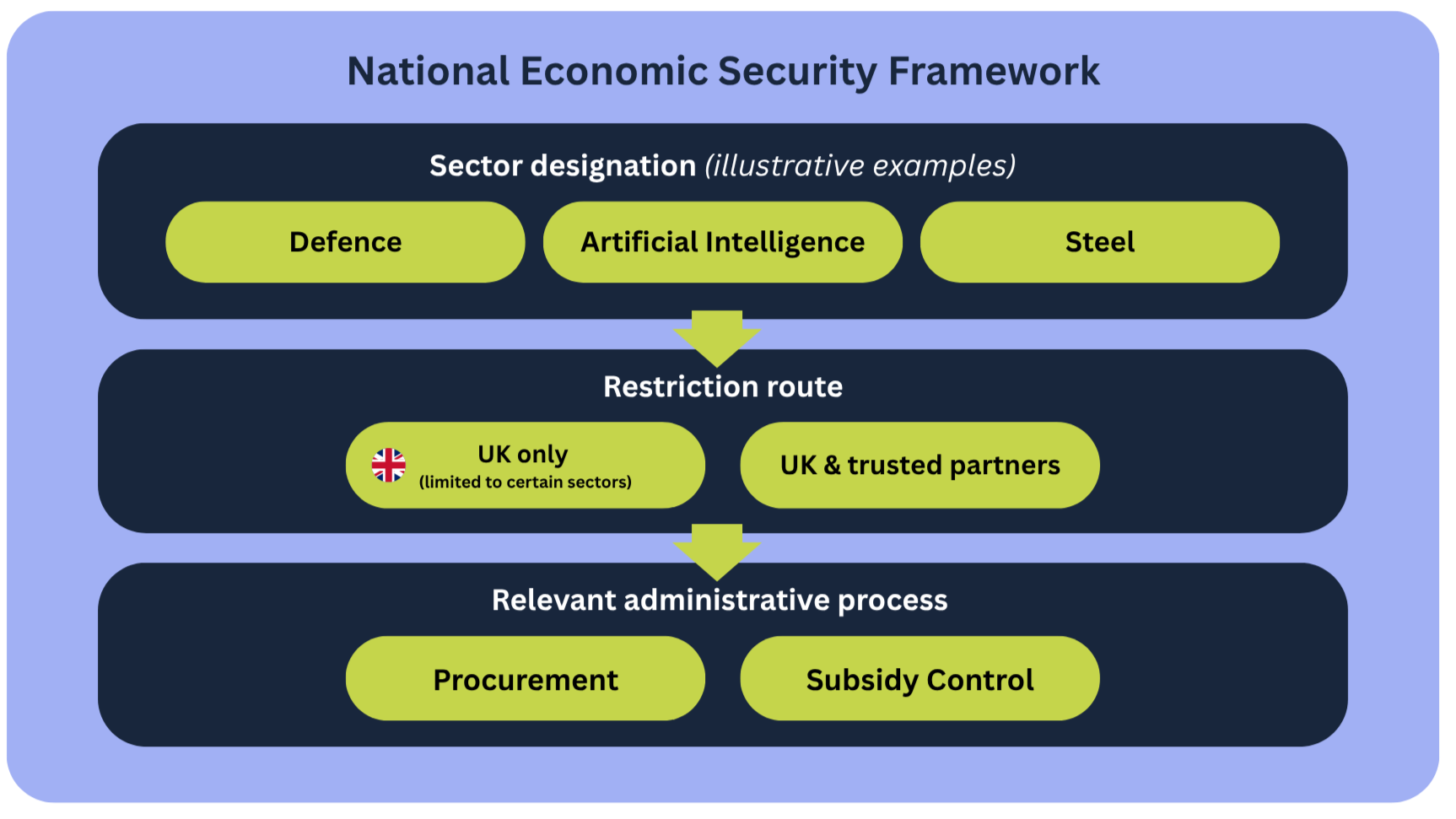
We propose creating a formal list of capabilities and sectors where the government considers maintaining domestic capability an essential national-security interest. A designation would then require any subsequent decisions about the procurement or subsidy to be put through a national economic security framework, to consider limiting the activity to British companies exclusively or alongside trusted partners.
In relation to some capabilities and where international agreements allowed, the UK could restrict eligibility to UK-only participants (e.g. defence sits outside the UK’s GPA Schedules), in other sectors that are covered by the GPA or trading agreements, eligibility could be restricted to GPA and FTA partners, and would therefore exclude countries such as China and Russia.
Figure 4: How a new national economic security framework could operate
Procurement
The Procurement Act 2023 lets a public body award a contract without competitive tendering and restrict it to UK or trusted suppliers where it can demonstrate it is doing so for reasons of national security. The government has already begun using this for a small number of sectors but on a case-by-case basis, with each contract requiring its own fresh justification.
Our proposal would use the same tool more systematically and consistently. We propose using the existing UK national-security exemption to allow government procurement to be restricted to UK/trusted suppliers where maintaining a strategic capability, as designated, is necessary for national security. Where an area's supply chain resilience is the primary concern rather than a single company's ownership, that area would typically be assigned the UK and trusted partner route (see below) rather than UK-only, allowing genuine allied-country suppliers to participate, while still requiring every company on that route to clear the same ownership/control test.
Subsidies
Similarly, the Subsidy Control Act 2022 exempts subsidies given to safeguard national security from the normal subsidy control requirements, but there is no common framework for limiting eligibility of subsidies to UK based entities for national security reasons. Our proposal would apply the same systematic approach to subsidies as to procurement. Grants and other incentives would only be available to UK entities (or other partner countries where necessary under trading agreements) where the underlying activity takes place within a designated capability.
Supporting UK SMEs through public procurement
Regionally Significant Infrastructure Projects (RSIPs)
Devolved authorities and Mayors increasingly have the basic tools for strategic economic development but the lessons of large strategic developments in London, such as the site of the London Olympics, Canary Wharf and Nine Elms provide inspiration for going further to support economic development across England.
The English Devolution and Community Empowerment Act 2026 gives Mayoral Strategic Authorities a significantly stronger role in strategic planning and development. Once the necessary secondary legislation is in place, mayors will have powers to intervene in planning applications of potential strategic importance, make Mayoral Development Orders granting planning permission for specified development, and, where a Spatial Development Strategy is in place, introduce a Mayoral Community Infrastructure Levy (MCIL) to raise funding from new development for strategic infrastructure. These powers build on the existing London model and represent a significant expansion of the tools available to mayors outside London.
While some projects have the potential to deliver cross-border improvements within a Combined Authority, where these projects fall short of being classified as a Nationally Significant Infrastructure Project they must be considered first by the Local Authority. While Mayors increasingly have the power to call-in a decision by a Local Authority, this can cause lengthy delays before a project is approved. We therefore believe that the existing route for getting Nationally Significant Infrastructure Projects approved directly from the Secretary of State should be replicated for Mayors to approve Regionally Significant Infrastructure Projects (RSIP). The qualifying criteria for an RSIP should be lower than the criteria for an NSIP e.g. reservoirs over 30m m3 are considered an NSIP but reservoirs between 15m m3 - 30m m3 to be considered as an RSIP.
Devolving planning choices on the environment and design
For RSIPs, we should also provide Mayors the power to vary the requirements of the habitats regulation, nutrient neutrality and biodiversity net gain by paying into a fund. In each case the obligation is not removed, it is discharged differently and at a scale where it does more good. Parliament has already accepted this logic for nature: Part 3 of the Planning and Infrastructure Act 2025 lets developers pay a levy into the Nature Restoration Fund instead of producing site-by-site mitigation, on the explicit basis that pooled, strategically targeted conservation delivers more than fragmented offsets. This principle should be extended to other areas with the possibility of regional mayors establishing funds instead of requiring site-by-site compliance.
Devolving powers for an integrated modern transport strategy
While Mayors hold responsibility for Local Transport Plans and Spatial Development Strategies covering how people move around their areas, they lack the powers to approve the full range of transport modes that a modern transport strategy now has to accommodate. The rules and licensing arrangements governing e-bikes, e-scooters, autonomous vehicles, and drone and robot deliveries are set variously by the Department for Transport, the Civil Aviation Authority, the Secretary of State and individual councils. The result is that a mode capable of filling a gap in the network may be outright illegal, may be waiting on a national evaluation, or may be permissible only in those councils that have agreed to it, each having chosen different operators with different conditions.
The English Devolution and Community Empowerment Act has begun to correct this, giving strategic transport authorities the power to license shared e-bike schemes, with TfL taking that role for London rather than the 33 boroughs. But the power awaits secondary legislation and is not yet in force, and it covers one mode. Mayors should instead be given a broader authorisation power that can respond to changing demand and new technology, rather than waiting for Parliament to legislate mode by mode, a decade at a time.
The only lawful route for rental e-Scooters is a nationally managed pilot scheme as e-Scooters remain banned under the Road Traffic Act 1984. Pilot e-Scooter rental schemes began in July 2020 and have now been extended for a fifth time, to May 2028, while a second national evaluation continues and is due to conclude this year. Autonomous vehicles are permitted through licenses granted by the Secretary of State with the DVSA assessing applications, while autonomous taxis are subsequently permitted through taxi licensing authorities, meaning individual local authorities, districts and unitaries outside London rather than the Mayor provide the relevant licenses. Drone delivery sits entirely with the CAA, which requires a Specific Category operational authorisation and, for most viable delivery routes, separate Beyond Visual Line of Sight approval, with the regulator's roadmap targeting routine BVLOS operations from 2027. Pavement delivery robots have no national framework at all, so deployment depends on whatever arrangement an operator can strike with an individual highway authority.
The net effect is that Mayors do not currently have the tools to quickly react to changing demands and to innovate and create new economic opportunities with future modes of transport in their area. We therefore propose providing Mayors with stronger powers over the widest range of transport modes as possible, rather than the current patchwork of local authority and national permits.
Devolving new growth incentives
Public procurement is one of the most powerful and direct levers available to the Government to support its ambition of delivering good growth in every postcode. The public sector spends around £430 billion a year procuring goods, services and works, representing a substantial market for businesses across the country. How the Government structures and awards contracts can influence the strength of local supply chains and support growth across the country. In particular, SMEs - accounting for the overwhelming majority of UK businesses - stand to benefit significantly.
However, SMEs face significant barriers to accessing public contracts. Large contracts can exceed the financial and administrative capacity of smaller businesses, forcing them either to bid as part of a consortium or rely on subcontracting from larger companies who have greater resources but also take a cut, meaning SMEs get less than they otherwise would have if they won the contract directly.
Reserving below-threshold procurements
While international treaties prevent procurements over a certain threshold from being reserved for UK based companies, ‘below-threshold’ procurements can be reserved for UK based suppliers and/or SMEs. The existing procurement policy allows for this but it does not require it. The Government should go further and flip the default, requiring below-threshold procurements to be reserved for UK SMEs unless there is a good reason not to do so. This would reserve about £1bn of public procurements for UK-based SMEs by default.
Breaking down procurements and simplifying administration
Above-threshold procurements can also be broken down into ‘lots’ and there is an existing duty for contracting authorities to ‘consider’ whether ‘lots’ should be used, but there is no requirement on a contracting authority to pursue ‘lots’, with a simple explanation enabling the avoidance of ‘lotting’. Breaking down contracts into distinct elements can be helpful in ensuring SMEs are able to access narrower aspects of larger procurements, enabling them to participate and develop new skills by working alongside other larger suppliers. While government guidance promotes lotting of larger procurements, it does not require it. We consider that lotting should be the default, particularly where there are distinct geographical, functional or product components.
However, even where lotting is used to break down a procurement into smaller components, all those components must follow the administrative process of an ‘above-threshold’ procurement, even where the individual lot is below-threshold. SMEs which wish to be successful with that procurement, must go through a more burdensome procurement process to do so. While it is not possible under international rules to break up a procurement for the purpose of limiting it to UK suppliers, it is possible that smaller lots that would otherwise be considered below-threshold could be subject to a less burdensome procurement process.
Supporting the UK agricultural sector through procurement
The procurement of food in the public sector has the potential to support the UK agriculture sector and improve food resilience in the UK. Where a public procurement is below-threshold, UK SME farms and businesses will benefit from our above policies on reserving ‘below-threshold’ for UK SMEs unless there is a good reason not to as well as breaking down larger contracts into smaller ‘lots’. However, many public procurements for food are delivered through larger contracts that would typically be above-threshold and cannot be reserved for UK SMEs under international rules. However, other countries have found ways to support their domestic agricultural sectors within international rules by setting clear expectations on quality, sustainability and supply chain requirements that match their domestic rules. As the UK has higher agricultural standards on many agricultural products, even in comparison to the EU, the UK could include these requirements in the public procurement of food and catering services to ensure UK-based suppliers are best placed to win those contracts or benefit from them through the supply chain. This could include requiring statuses such as organic, free-range, Red Tractor or Marine Stewardship Council approved. In France, the ‘EGalim’ law requires 50% of any food or catering contract to meet the requirements for ‘durability and quality’ which can be met through a range of food classifications similar to the ones outlined already. This rises to 60% for sustainable meat and fish products. Where those contracts relate to the central French government, the requirement is that 100% of food procurements must meet these standards. The UK should match these expectations in its own procurement rules and align the standards with UK agricultural standards.
With special thanks to…
Jade Azim
Tom Doherty
Louisa Dollimore
Katy Dillon
Kai Hain
Ruby Herbert
Ben McGowan
Max Mosley
Praful Nargund
Dylan Turner