


October 2025
Take Back Control
How solving the UK’s skills crisis can move the political dial on immigration
“The Government needs to put more money into the people that are born here. They’re only bringing the immigration in because people don’t want the jobs or they’re not trained up. This is where the training comes back in. They need to do more training, intense training, of people already here. Spend the money that way.”
- Woman, Labour-Reform Switcher, North West Leicestershire
Foreword
Former Home Secretary and Secretary of State for Education and Employment
By Rt Hon Lord David Blunkett
For nearly two decades, Britain has been grappling with the same underlying problem: a persistent failure to invest in our own people. We have spent years talking about growth while allowing our skills system to stagnate. The result has been an economy that too often relies on quick fixes - on importing skills instead of building them, on managing decline rather than fostering renewal.
At the same time, immigrants, who are an integral part of our society and economy, have become an easy target for public frustration. The reality is that, over centuries, Britain has benefited from an injection of the talent, work ethic and cultural contribution of so many who have sought to make their lives on these shores. As Home Secretary, I saw this first-hand. But I also saw the importance of an immigration system that balances fairness with firmness - one that welcomes those who have come here to contribute, while ensuring that opportunity at home is widespread.
Our political problems will not go away if we continue to walk the path we are on now. The challenge is to build cohesion. To give British workers the skills and ability to create the lives they are proud to lead, while continuing to welcome those who come here to contribute to our shared success.
This report sets out a serious, pragmatic plan to “take back control” in the truest sense - not through slogans or scapegoating, but by giving people real power over their own lives and the confidence of aspiration once again. It recognises that the public’s unease about immigration cannot be separated from their frustration about opportunity. When people feel locked out of progress, resentment grows; when they see investment in skills and prospects, confidence returns.
The link between skills, opportunity and social cohesion has long been clear to me. As Secretary of State for Education and Employment, I saw how expanding education and lifelong learning could transform lives and communities. If we want to rebuild faith in politics and revitalise our economy, we must put skills and opportunity at the centre of both.
What this report shows is that skills policy is not an add-on. It is the foundation of a fair, confident and productive country, and the answer to one of our most contested issues - immigration. The Good Growth Foundation makes a compelling case for a new framework that connects domestic training, industrial strategy and immigration in one coherent mission: to equip Britain for the future.
By aligning skills spending with the sectors driving our growth, reforming immigration around contribution and partnership, and visibly reinvesting in British workers, this agenda can rebuild public trust while strengthening our economy. The challenge now is to turn these ideas into action. If the government wishes to be seen as firmly in the driving seat, joined-up thinking and action, and a clear direction of travel should start now.
Introduction
Praful Nargund
Director of The Good Growth Foundation
The UK’s debate about immigration is out of control. While the political right is persistently upping the ante on anti-immigration rhetoric, progressives have struggled to respond. Burying their heads in the sand or cosplaying the right have been the only two modes of retort - leaving everyone in this country, British or foreign-born alike, to suffer the consequences of increasing hostility. Yet, there is an answer and it has been here all along.
Lurking behind the headlines, but on the tip of voters’ tongues, skills and training have had short shrift in today’s politics. Across our research, we have found improving the availability of skills and training to be one of the most popular methods of growing the economy (Mind the Growth Gap), and, frankly, focus groups love it. But rarely, if ever, are skills and immigration policy designed to work in coordination with one another, despite both being key to addressing labour shortages across the economy.
This lack of focus on skills is a peculiar feature of the conversation, considering how central to the issue they are and how much voters see adult education in particular as a path towards a better life. Antagonism towards the immigration system as it currently functions is not just about culture, it's about an economy in crisis. The cost-of-living crisis, the housing crisis, public services in crisis - the list goes on. People in Britain feel stuck. With rising housing costs and people struggling to get a well-paying job and put food on the table, immigration becomes a target.
It doesn’t have to be this way. In this report, we outline how progressives can use skills and opportunity to take back control of the debate and find their voice on immigration - even paving a way to reduce hostilities. Winning this argument properly means focusing on what Britons actually want, which is more than just bringing the immigration figures down. They want visible investment in their skills, jobs and prospects.
A lack of opportunity is the undercurrent driving many Britons’ anxieties. Where jobs are good, pay is fair and training offers people a way forward, immigration is seen as a benefit. Where these are missing, it becomes a source of fear. By championing skills reform - which voters see as a proxy for better jobs and greater opportunity - and using immigration to shift the system in this direction, progressives can tackle the problem at its root. Because Britons are actually optimistic about the contributions immigrants can make, but wary of increased competition for what feels like ever-diminishing resources at a time when they feel most disempowered and under-skilled.
Crucially, this agenda unites Labour’s electoral coalition. Our research deliberately focused on Labour-Reform Switchers and the Labour Left - two groups that rarely agree on matters of immigration. Yet, both respond positively to a message that links skills, growth, contribution and commitment. It is a universal story about investing in British workers, rewarding those who contribute and building a fairer economy that works for everyone.
By moving the conversation toward how high-skilled immigration can help the country achieve its ambitions while explicitly giving people already here greater opportunities, it means the progressive left can win the argument without simply aping the right. Few now buy the “stop the boats” narrative (either from the Conservatives or Labour). A new approach to addressing the public’s anxieties about legal migration is needed to not echo that failure. One that shows the Government is prioritising Britons’ chances to get ahead and demonstrates immigration can be part of the solution, not the problem.

“I think obviously economic benefits for yourself. You’re going to be hopefully earning more money if you’re better trained, or if you are upskilling to get a better job or a new career. It might be a better paid one but also lifting people out of that economic inactivity as well, which helps everybody.”
- Woman, Labour Left Bexleyheath and Crayford
Executive Summary
This report sets out a new framework for taking back control - one that links skills reform and immigration policy into a single, credible project to restore hope and opportunity across the UK.
Skills and training are one of the most politically salient issues with voters across the UK, but have too often been undervalued by successive Governments. And few make the connection between skills and immigration, despite the fact that they readily go hand in hand. Britons’ concerns about immigration are not just about numbers or borders, but about pressure on the system - the belief that immigration has crowded out opportunities, stretched public services and exposed how little has been invested in British workers.
To counter this narrative, the Government must not only make immigrants’ contribution and commitment to the UK clear, but it must also increase opportunities for Britons here at home.
Immigration: Turning Pressure into Partnership
Public attitudes to immigration are shaped by concerns about pressure on housing, healthcare and wages, and by the belief that it can crowd out opportunities for British workers. This is true for those from the Left and Right of UK politics.
74% of the public say they are very or fairly concerned about immigration, including 63% of the Labour Left and 82% of Labour-Reform.
52% believe the UK economy will always need some level of immigration to grow and fill jobs, but a strong minority (39%) reject this premise entirely.
68% are comfortable with highly skilled immigration, and only 10% are uncomfortable.
But 50% believe immigration has decreased the need and incentive to train British workers, and 56% think it has reduced training and upskilling opportunities.
Recommendations
Public opinion softens dramatically when contribution and commitment are visible.
Framing immigration around a “work and teach” concept - where skilled foreign workers help train and mentor British colleagues - reduces those very concerned about immigration by 18 points and overall concern by 12 points. People want to see that those who come to the UK are not competing with British workers, but contributing to shared success.
This is the foundation for a new approach:
A dynamic points-based immigration system that recognises contribution and commitment, not just salary or qualifications.
A Work and Teach Pathway, requiring skilled migrants to dedicate part of their time to mentoring and training British workers.
A Migration Budget that transparently shows how migrants’ fiscal contributions and social commitments are reinvested into British jobs, training and communities.
Together, these policies would rebuild trust by turning immigration from a perceived pressure into a visible partnership.
Skills: Creating opportunity at home
Skills reform is the missing link in the UK’s economic story. Voters want Government investment in people that matches its ambitions for the economy, and they are clear on how this should be done.
60% believe adult training should mostly take place in the workplace.
71% say employers and businesses should be most responsible for delivering it.
75% associate apprenticeships with learning a trade on the job; only 14% see them as formal, exam-based courses.
Recommendations
Britons want a skills system that serves the economy and the sectors driving future growth, in turn boosting wages for them and their families.
79% support Government encouragement for people to take up careers in shortage sectors - only 3% somewhat oppose and 0% strongly oppose.
50% say Government promotion of careers in key sectors would influence their choices.
We propose a more targeted approach for the Levy aimed at supporting full flexibility for the Industrial Strategy sectors (IS-8) identified in the Government’s Modern Industrial Strategy. This would drive visible domestic opportunity while creating significant fiscal benefits, such as increasing wages and productivity. So much so, we believe it would meet the Office for Budget Responsibility's test of “additionality” - ensuring every pound spent on skills yields measurable gains in productivity and wages. That means our proposals not only answer political calls for fairness, proving Britain is investing in its own people, it also allows the Government to boost fiscal headroom.
Methodology
This report is based on:
1 x nationally representative online poll of 2,012 GB adults, conducted by The Good Growth Foundation between the 2nd and 7th of July 2025.
Disclaimer: In this poll, results have been rounded up or down to the nearest whole number to remove the decimal place in our results tables and graphs. Due to rounding, totals may not always sum to 100%.
4 x focus groups, running across two evenings (12th June and 10th July 2025).
3 x groups with Labour-Reform Switchers: 2024 Labour voters who say they will vote for Reform at the next election.
1x group with Labour Left: 2024 Labour voters who say they will vote for an alternative left of centre party, such as the Liberal Democrats or Greens, at the next election.


Section 1
Contribution and Commitment
Rebuilding trust on immigration
Public attitudes towards immigration are complex, but not immovable. Across focus groups, voters consistently distinguished between different types of migration. Highly skilled workers - doctors, nurses, engineers - were broadly welcomed as essential to the UK’s success, while lower-skilled migration was met with more scepticism. What softened concerns, however, was visible contribution and commitment. People responded positively when migrants were seen to be filling NHS vacancies, training British workers, or clearly benefiting local communities.
Our polling on a proposed “work and teach” pathway shows how powerful this framing can be. When people could see migrants both contributing their skills and directly helping to train others, concern about immigration dropped dramatically - in fact, decreasing those significantly concerned by 18 points. Focus groups reinforced this finding, with participants saying the system felt fairer when newcomers were not seen as competitors for scarce opportunities, but as active partners in building skills at home.
This points towards a new way of taking back control of this discussion: linking immigration explicitly to the promotion of opportunity in the UK. Immigration policy cannot be treated as a substitute for domestic training. Instead, it should work hand in hand with skills investment - so that the money and infrastructure are in place for people here to take advantage of the system.
A more dynamic points-based immigration system could make this principle possible and build on a truth that came through strongly in our research - that symbols matter. People want to see evidence that the system is working for them, not against them. Contribution and commitment are the clearest signals that immigration is a complement, instead of a competitor.
Finally, visibility is critical. Many participants said they valued skilled migrants most when their contribution was clear, such as in the NHS. But too often, the essential work immigrants do across the country is hidden. A long-term work and teach programme would not only ease shortages but also show the public, in real time, that immigration is strengthening Britain’s skills base rather than undermining it.
Solving the Shortcut
1.1
Concerns about immigration are not abstract. They are often rooted in a lived sense of competition - over jobs, wages and scarce public resources. While many Britons recognise that skilled foreign workers fill crucial gaps in the labour market, unease about the impact on British workers remains both widespread and deeply felt. Three-quarters of the public (74%) say they are very or fairly concerned about immigration - including 63% of the Labour Left, 67% of 2024 Labour Voters overall and 82% of Labour-Reform Switchers.
Just over half the public (52%) believe the UK economy will always need some level of immigration to grow and to fill jobs that British workers cannot. But this still leaves a sizable minority (39%) that rejects the premise outright, believing the economy does not need any immigration at all. These divisions are particularly sharp within Labour’s electoral coalition. A clear majority of Labour voters (58%) - and even more on the Labour Left (70%) - see immigration as necessary, but among Labour-Reform Switchers support collapses to just 37%. The pattern flips when looking at those who reject the need for immigration: 61% of Labour-Reform switchers take this view, compared to 31% of Labour voters overall and just 27% of the Labour Left. Our policy agenda linking immigration to skills therefore carries strategic importance: it offers Labour a way to reassure swing voters that the party is serious about investing in domestic talent, without alienating its pro-immigration flank.
A sharp concern from voters is the impact of immigration on training and skills development. Half the public (50%) believe immigration has decreased the need and incentive to train British workers, while 56% think it has reduced upskilling opportunities. These concerns are especially strong among Labour-Reform switchers (65% believe immigration has decreased the need and incentive to train British workers and 66% think it has reduced upskilling opportunities), indicating that the perception of lost opportunities is a major factor for their anxieties.
The idea that immigration is used as a “shortcut” instead of investing in home-grown talent was a recurring theme in focus groups. Many participants felt the Government and employers had become too reliant on overseas recruitment, rather than building skills and capacity among the domestic workforce. And this frustration was particularly pronounced on behalf of those in low-skilled jobs. Highly qualified professionals were generally seen as insulated from competition, while those in lower-skilled jobs are viewed as more vulnerable. As one Labour-Reform Switcher said, “It depends on qualifications and skills. I’m sure doctors, surgeons, lawyers and barristers are not having any issue with the competitiveness from immigration. But unskilled or unqualified young men and women, then I could see it being more of an issue there for finding work.”
Anxiety over depleting job prospects and fewer resources, broadens to a deeper fear about the UK’s ability to accommodate new arrivals. This goes beyond culture - immigration was frequently cited as a source of pressure on housing, healthcare and public money. One Labour-Reform Switcher summed it up bluntly: “I just feel like that the country can’t cope with the current numbers of people, really. There’s not enough infrastructure.”
There was a perception that resources directed towards immigrants meant less investment in people already here. For many sceptics, the case for immigration becomes far stronger when it is framed as a complement to, rather than a substitute for, meaningful investment in British workers and communities.
Consequently, the Government must make it more transparent how the economic contributions of immigrants - through income tax, National Insurance, visa fees and the Immigration Skills Charge - are invested directly back into the training, jobs and public services on which people depend. One way of doing so would be through a Migration Budget in which the government would publish the costs and benefits of migration in a given time period, which would show in black and white how immigration strengthens Britain’s economy, by tracking not just costs but the additional growth and tax revenues generated by immigrants’ work and economic activity. Crucially, it could also demonstrate how those resources are being reinvested in domestic skills and opportunities.
This could flip the narrative. Immigration would no longer be seen as a zero-sum game where every gain for newcomers is a loss for British workers. Instead, it would be seen as a system that expands the pie, funding more training places, creating more jobs, and putting money back into the communities that need it most. For sceptics, this distinction is decisive. Immigration framed as a substitute for investment in Britons is resented. Immigration framed as a complement - directly tied to expanding opportunity at home - can command broad support.
“The Government is spending a lot of money on this other immigration. That means there’s less chances for everyone else because there’s more money going into that.”
- Man, Labour-Reform Switcher, Newport East
The Skills Premium
1.2
Attitudes towards immigration shift significantly depending on the skills immigrants bring. At its core, the dividing line is contribution. When people see immigrants filling vital roles, bringing advanced qualifications or addressing a shortage in essential services, support is strong. But, where immigration is perceived as low-skilled, and therefore understood as in direct competition with British workers for scarce jobs and resources, scepticism hardens.
Nearly seven in ten (68%) say they are very or quite comfortable with highly skilled professionals - those with advanced qualifications and expertise - coming to the UK. This level of support is consistent among Labour voters, and while lower among Labour-Reform Switchers, still a majority (55%) are comfortable with highly skilled migration. Only 10% of the public say they are uncomfortable - proof that skilled migration is seen as a positive sum for the economy and society.
By contrast, attitudes towards lower-skilled migration are far less forgiving. Only 32% of the public are comfortable with it, with under half (43%) of the public uncomfortable. Among Labour-Reform Switchers, discomfort spikes to 58%. Labour voters, while more tolerant, are still divided (36% uncomfortable, 40% comfortable).
This divergence makes the political path clear. Immigration reform must lean into contribution, commitment and visibility. Highly skilled migration commands legitimacy because people can see the benefit. NHS nurses keeping wards open, engineers building infrastructure or digital specialists driving growth all provide tangible evidence of how migration strengthens the country. In contrast, low-skilled migration is often framed as in competition for jobs, wages and housing - particularly in communities already under economic pressure.
The Government can respond directly to public attitudes by creating a smarter immigration system that recognises the many ways migrants contribute to Britain and reflects what the public values most - contribution and commitment. By making the principle of partnership visible through a modernised points-based system that rewards those who work in shortage sectors, help train others, and put down roots in the UK, immigration can once again be seen as a force for national renewal, strengthening opportunity for those who come here and those already here alike.
“So I welcome all the skilled people that have all the checks. The other people? I’m sorry I don’t welcome them all.”
- Woman, Labour-Reform Switcher, Lichfield
Changing Hearts and Minds
1.3
Concerns about immigration do not arise in a vacuum. They are grounded in deeper fears about economic competition, stretched infrastructure and a long-standing sense that Britain has under-invested in its own people. When voters feel the system puts newcomers ahead of them, resentment grows. But when they can see that migration is helping to strengthen the country - by building skills, supporting public services and investing in British workers - those anxieties soften. The route to greater acceptance lies not in rhetoric, but in visible contribution.
Support for skilled migration is already strong. Two-thirds (68%) of the public say that skilled immigrants who come to work and contribute are helping Britain succeed - including 72% of Labour-Reform Switchers. Only 20% overall believe skilled immigrants are not helping. This reflects a clear pattern: contribution changes minds. When people can see the benefit of immigration in their daily lives, their instinctive unease fades.
Policies that make that contribution tangible are particularly effective. Our polling shows that framing a visa around both working and teaching reduces those identifying as very concerned about immigration by 18 points and overall concern by 12 points, compared to the control. Almost half of the public (49%) are comfortable with migrants coming to “work and teach”, helping to address shortages in sectors where there are not enough British workers to train the next generation. Among Labour voters, that figure rises to 57%. The appeal lies in fairness: people welcome immigration when they know it is helping to build opportunity here at home.
Condition 1: Skills
Imagine that the following was going to be true in 2029… The UK now has a world-class skills and training system for British citizens, meaning workers in Britain are able to upskill.
Condition 2: Work and Teach
Imagine that the following was going to be true in 2029… A “Work and Teach Visa” now allows migrants to come to the UK to work, while also training up British workers in their sector. This is targeted at sectors where there is a shortage of British workers, and there are also not enough British workers who have the skills currently to provide the training.
Condition 3: Control
How concerned, if at all, are you about the impact that immigration will have on workers in the UK in 2029?
The ‘Work and Teach’ model responds directly to that public instinct. Under this proposal, skilled foreign workers would be granted visas on the condition that part of their time is dedicated to training and mentoring domestic employees - sharing their expertise with local workforces, SMEs and colleges. It transforms immigration from a perceived shortcut into a visible investment in Britain’s own talent pipeline. In a labour market still recovering from years of undertraining and chronic shortages, this approach would make migration a tool for renewal rather than a source of tension.
In focus groups, we found this logic plays out clearly. Support for skilled migration rises sharply when people can see direct, tangible benefits - whether that’s filling NHS vacancies, delivering specialist training or enriching communities economically and culturally.
“Legal [migration] is too low. We need more skilled people coming in for the NHS.”
- Woman, Labour-Reform Switcher Rother Valley
For some, the urgency of skilled migration had been sharpened by Brexit. Even Labour-Reform Switchers noted leaving the European Union has had negative consequences regarding the availability of skilled workers in the UK. One man said: “I think probably when the Brexit happened, I think since then, like, we had, like, a major impact in terms of, like, a skilled workers, yeah?”
Still, support for skilled migration comes with a condition. It must complement, rather than replace, investment in British workers. Across political groups, participants emphasised that the long-term goal must be to strengthen the domestic workforce while maintaining the openness needed to fill urgent gaps.
“I actually hate myself for writing that because I’m down with migrant workers, and I don’t have an issue with it but I know a lot of people do … A message that would ring with some people of certain views at the moment would be, well, we don’t need to hire the migrant workers if we can upskill our own people to do the jobs that need doing, that actually at the moment, none of you really want to do.”
- Woman, Labour Left, Poole
This balance - between welcoming contribution and prioritising domestic opportunity - is at the heart of how to shift public attitudes. People are generally not anti-immigrant by instinct; they are pro-fairness. They want to know that immigration works for everyone.
The solution is not to retreat from immigration, but to rebuild confidence in how it is managed. When contribution is visible, commitment is understood and fairness is felt, attitudes soften. Policies like the Work and Teach Pathway show how to turn migration from a source of division into a shared national project - one that expands opportunity, supports public services and rebuilds the public’s faith that Britain is in control of its future.
“If there’s more skilled workers [...] in house, if we’re sort of not having to import as much, if we’ve got the skilled workers in the country, then obviously there’s not as much cost there. And even the potential to export.”
- Woman, Labour-Reform Switcher, Bridgend


Section 2
A Broken Bargain
Why Britain must invest in its people
For decades, the UK’s economy has been sustained by a simple logic: where we face a skills shortage, fill the gap with immigration. It is a policy approach shared by successive Governments, grounded in a distinctly neoliberal view of immigration - that it is primarily a tool for improving the country’s competitiveness and GDP. But in this pursuit of short-term fixes, something has been lost.
“First thing that springs to my mind is things like apprenticeships and, you know, getting young people, or I guess at any age, into a working place where they can work and learn and grow.”
- Woman, Labour Left, Poole
“I think it sort of has a snowball effect to a better society in general. People with more sort of higher level of skill set, obviously, if they’re doing well, it snowballs into everyday life. Out in society, out in the community. It’s just all around better, isn’t it really?”
- Man, Labour-Reform Switcher, Barnsley South
The British public feels they have been cut out of the bargain. Immigration has been framed as an economic necessity, filling immediate vacancies but failing to address the deeper problem: why aren’t Britons themselves able to access these jobs?
It is a failure that has had cascading consequences. Skills training has been deprioritised. Further education has been hollowed out. Adult learning is barely visible in the policy landscape. Meanwhile, the “university or bust” model that dominated the 2000s has left many young people with debt but little sense of purpose. And many others, who never took that route, are left feeling abandoned by a system that offers them no real way forward. So low has skills and training sat in successive Government’s priorities that the Office for Budget Responsibility (OBR) has not directly considered policies in this area for scoring, despite the fact that skills and training reform can indeed create significant economic benefits.
As a result, people see opportunity shrinking around them. They want to do better, to retrain and move forward - but the routes aren’t visible. Careers advice is thin on the ground, particularly for adults at career crossroads. Training is patchy and often misaligned with the critical areas where the country most needs skilled workers - from healthcare to construction, green energy to tech. The result is a sense of immobility, feeding the perception that resources are scarce and competition is fierce.
“I just think the more you learn, the better obviously your wages will be and the better quality of life.”
- Woman, Labour-Reform Switcher, North West Leicestershire
The consequences are dire for our economy, and our politics. With people feeling themselves falling further behind, unable to find good, well-paying jobs close to home, immigrants face the brunt of the ire. Why are they getting the jobs? Why are they getting the housing? Why are they getting the benefits? Resentment builds, not simply from prejudice, but from the experience of being shut out.
Progressives cannot meet this challenge by chasing GDP figures or echoing anti-immigration rhetoric. Instead, it must make the case for skills as part of a good growth strategy - one that opens doors for people here, while welcoming those who come to contribute. This is both good economics and good politics. Voters strongly support investment in skills, seeing it as the surest route to better jobs, higher wages and more opportunities. And it offers the Labour Government a rare point of unity across its own internal divides.
A skills-first approach reassures voters that British workers will be trained and supported, while keeping the openness needed for immigrants who sustain so much of our country. Linking immigration policy to a revitalised national skills strategy is a way to combine fairness with pragmatism - investing in our own people, while recognising the contribution and commitment of those who come here to work hard and succeed.
What does “opportunity” mean?
2.1
In our foundational report, Mind the Growth Gap, we argued that voters want a Government that gets behind ordinary people so that they can pursue opportunity again. This means the chance for a better life - a decent job, fair pay and a route out of ever increasing financial insecurity. The problem is that for too many, those opportunities simply don’t exist.
We heard this repeatedly in our focus groups. People want to work, they want to improve their lives, but they don’t see clear pathways to do so. Jobs feel inaccessible. Training feels distant. Social mobility feels out of reach. They feel stuck.
This is a problem not just for individuals, but for the economy as a whole. A country where people cannot access opportunities is one where potential goes to waste.
Opportunity means a “better life for people being able to get a job.”
- Man, Labour-Reform Switcher, Wakefield and Rothwell
“So there’s no jobs up there [on the highstreet], and there’s no opportunities for anyone not in my area anyway.”
- Woman, Labour-Reform Switcher, Erdington
“The only [young people] that I ever find out that have actually got jobs, is because a friend of a friend is already employed by that company and then puts their name forward […] They’re applying and they don’t think the job’s there.”
- Man, Labour-Reform Switcher, Erdington
What does “skills” mean?
2.2
In politics, “skills” is often treated as a rather nebulous term. But for the public, the meaning is far more concrete. When people talk about skills, they usually mean two things. First, the practical trades - plumbing, mechanics, carpentry - came out on top in our polling. These are the kinds of abilities you can start to put to work straight away. Second, the digital skills that symbolise the future - computers and coding, which mean people can keep pace with a fast-changing economy - were also highly valued
And when people think about how to gain these abilities, their answers are just as clear. They first look to apprenticeships, followed by technical qualifications like BTECs or NVQs and then to in-work training within an existing job. Skills are not seen as abstract learning but as hands-on preparation for real jobs. As one man in a Labour-Reform Switcher focus group explained: “I think it’s based on the practical.” Or as another put it: “I put tangible and usable because, for me, a skill is something that somebody wants or needs [...] It’s not just theoretical [...] it can be put into practice.”
Crucially, however, skills aren’t just about employability, they’re about hope for a better future. The most popular reason people give for wanting to learn new skills is simple: to earn more. As one Labour-Reform Switcher said, “I just think the more you learn, the better obviously your wages will be and the better quality of life.”
But the system is failing to deliver. Four in ten Britons (43%) say the UK is doing quite badly or very badly at providing people with the skills they need to succeed. Only a quarter think we’re doing well. That gap between expectation and reality adds fuel to the fire of fear of the future. For voters, skills are both practical and future-facing. They are the route to better jobs, higher wages and greater opportunity - and people expect the Government to take them seriously.
“[Skills] just give you more opportunity, don’t it?”
- Woman, Labour-Reform Switcher, Heywood and Middleton
What does “apprenticeships” mean?
2.3
Apprenticeships come up again and again in our research. They are the most common thing people associate with the phrase “skills and training” and are widely seen as a crucial bridge between education and work, especially for those who don’t go to university.
But despite their popularity, the apprenticeship system has failed to meet expectations. The Apprenticeship Levy, the previous Government’s flagship policy on skills, has been widely criticised for being overly complex, inflexible, poorly targeted and, ultimately, underused.[1] Large employers have often treated it as a tax, rather than an opportunity to invest in new talent. Smaller businesses, meanwhile, frequently find the system too difficult to navigate at all.
Former Skills Minister Robert Halfon argues that this has been key to “huge progress” in transforming apprenticeships and skills education, but the public see it as a failure.[2] Largely, it is just not the system they want. Only 14% say a “formal government-recognised course with exams and certificates” comes to mind when they hear the word apprenticeship. The vast majority (75%) instead imagine “a way to learn a trade by working on the job.” For most, apprenticeships are understood not as a structured pathway to a qualification, but as a hands-on, entry level way to pick up practical skills - usually in a trade, and usually for young people.
This perception gap limits who sees apprenticeships, as well as wider skills and training courses, as being “for them.” Particularly, adults who would like to retrain but can’t find any courses catering to their needs.
Apprenticeships should be a vital tool for tackling skills gaps, opening up good jobs and helping people of all ages to move forward in life. But today, they are too often treated as an afterthought or for a small sub-sect of society. The underlying model of learning by doing - or ‘on-the-job’ training - remains one of the most popular and trusted ways to build skills. When asked where the Government should focus its spending on training, the public backed apprenticeships and on-the-job learning well ahead of classroom-based or generic professional development. But, as it stands, most people just don’t see apprenticeships as being an option for them.
“The most common age for an apprentice is probably 18 to 20. That’s the most common age. And most apprentices that I see in plumbing, gas, electrical are men. Are boys. But we are seeing quite a few girls come, and we always encourage that because we know they’re going to go far.”
- Man, Labour-Reform Switcher, Rushden and Wellingborough
[1] Camden, Billy. “DfE records £96m apprenticeship underspend in 2022-23.” FE Week, 26 September 2023, https://feweek.co.uk/dfe-records-96m-apprenticeship-underspend-in-2022-23/.
[2] Halfon, Robert. “Keep the Apprenticeship Levy for apprenticeships.” The New Statesman, 6 February 2024, https://www.newstatesman.com/spotlight/economic-growth/skills/2024/02/apprenticeship-levy-skills-minister-robert-halfon.
When life gets in the way of getting ahead
2.4
Accessing opportunities to retrain, upskill or pursue vocational qualifications remains difficult and unevenly distributed. Across our research, the picture is one of frustration - where people want to do more, to learn more and improve their prospects, but don’t know where to go.
There is an increasing sense that things are moving in the wrong direction. 38% of Britons say the country is getting worse at helping people build the skills they need. Only 25% believe we’re getting better. A larger share (39%) say that access to training opportunities is harder than it was a decade ago. Our focus groups were even more aggressive on this stance, with many nostalgic for polytechnics and skills centres.
“Well, 40 years ago we had things in place like apprenticeships. So by the time you got to 14 in secondary school, if you weren’t going to be academic, you know, you were funneled in off into what they would call the B classes and you would learn carpentry, metal work, etch, and then you’d go on to a polytechnic and get some kind of trade - plastering, brick laying and plumbing, electricians. That seemed to work. That was fantastic 40 years ago.”
- Man, Labour-Reform Switcher, Newport West
“I don’t even think we have anything like YTSs and that now, do we? Youth training schemes?”
- Woman, Labour-Reform Switcher, Darlington
This reflects a broken system - and a broken promise. The UK economy is supposed to be one where talent and graft are rewarded. At least, many think it used to be. But now the route to opportunity appears to be blocked. Those seeking to change careers, re-enter the workforce or retrain later in life face the most barriers. Over half the public (51%) say adults changing careers face the biggest obstacles to accessing skills and training, compared to 33% who say the same for young people.
If cost and time were not a factor, 64% of people would be interested in building new skills or taking up training, going up to 74% of working-age people. The demand is there, but the infrastructure and opportunity isn’t. As one Labour-Reform Switcher said, “Getting older, you’re too busy earning money to make money.”
In other words, too often, life gets in the way of getting ahead. Taking time off to retrain means losing income; something many can’t afford in an era of wage stagnation, high rents and soaring childcare costs. Another participant echoed this view, she said: “I’ve wanted to change my career for a long time, but being a parent I physically cant Because training means that I wont earn anything. So the only way to change and train is to be young, in my opinion. To be young, not have responsibilities and not have dependents.”
The cost-of-living crisis is not just squeezing households, it’s suffocating ambition. The main reason people say they’re unable to access training is simple: it’s too expensive.
The second major barrier is structural. 41% of people point to funding cuts and low government investment as the biggest barrier to skills and training opportunities. An even higher number (52%) say employers are failing to provide enough training or apprenticeships.
One man in our Labour Left group explained how this looks on the ground: “We’ve got a company of about 80 staff and we tried to take on one apprentice per year - and that’s across five branches across the north. So it’s probably not actually that many. One opportunity a year - it’s not that much. I think [the Government has] made it tough. A lot of opportunities come from small businesses and entrepreneurs, and they’ve made it tough for entrepreneurs with the National Insurance changes […] it’s costly now for businesses.”
This shortage is seen as particularly damaging for the poorest in society. Nearly 70% of Britons believe working-class and lower-income people face the steepest barriers to obtaining skills and training, while 14% say the same about middle-class people. And 65% say people in rural areas face the biggest barriers to getting skills and training, compared to just 13% who believe people in urban areas face the most difficulty.
This isn’t just about geography. It’s about a wider story of national neglect. Further education college budgets have been slashed, adult education has been left to wither and apprenticeships have been mishandled. There is a vast teacher gap in colleges. For decades, young people have been told there is only one route to success - a university degree - while other forms of learning have been undervalued or ignored. Yet, even that promise has faltered. Whether through higher education or alternative pathways, the system remains built around a narrow idea of what progress looks like. That bias has left too many people without a credible route forward. Graduates have been burdened with debt and uncertain job prospects and non-graduates have been locked out of opportunity altogether.
Even when training is available, it’s often not designed with real people’s lives in mind. Parents are priced out by childcare. Mid-career workers are expected to take pay cuts to retrain. And many part-time or flexible options simply don’t exist. It does not cater to people’s time or money commitments.
There is also a clear link between people’s sense of declining opportunity and the wider immigration debate. Half the public (50%) believe immigration decreases the need and incentive to train British workers, only 16% believe it has no impact. Whether or not this is borne out in policy terms, it speaks to the public’s perception that the system is skipping a crucial step: offering opportunities, firstly, to people who are already here.
People are ready to move up, but the ladder has been pulled away. We are not living through a crisis of ambition; we’re living through a crisis of access. Fixing this is as much an economic imperative as a moral one. If we want a thriving economy - one that grows with people, not around them - we must make it easier to access practical, meaningful skills. The good news is that this is one of the most popular routes to economic growth. People want to see a country that invests in them, not one that treats immigration as a cheap shortcut to plugging gaps.


Section 3
What People Want
Building a skills system that delivers for the public
When “education” comes up in discussion, many still picture schoolchildren in classrooms. But when people talk about what would make the biggest difference to the UK today, their focus shifts. They think about adults adapting to a changing economy, finding a way back into work after redundancy or learning new skills to move into better employment.
For many, the current system doesn’t provide enough help at those turning points. They want lifelong learning that is practical, accessible and tailored to the economy. That means stronger links between training and the opportunities that actually exist - and a much bigger role for employers, Further Education colleges and the local institutions making it happen.
In the public’s mind, this is about more than personal development. It’s about giving people the tools to keep up with economic change, fill urgent skills gaps and share in the growth of new industries. Whether it’s through better adult education, apprenticeships that work for both workers and businesses or training aligned with the Government’s Industrial Strategy, people want a skills system that delivers for them - and for the country.
Skills that pay the bills
3.1
Conventional wisdom says education investment should start at the beginning: early years and schools. But the public takes a different view. When asked what kind of educational investment would make the biggest difference to the UK today, people pointed firmly to adults. Nearly two-thirds (63%) say adult and lifelong learning would have the most positive impact on the country, far more than those who say the same for young people. Why? Because of the cost-of-living crisis. People want to earn more now, not eventually in 18 years' time. Parents want to earn more to provide for their children.
Yet the system has been stacked in the opposite direction. While skills and training sat in the Department for Education (DfE), it was left as a marginal afterthought. The Government’s recent decision to move the responsibility to the Department for Work and Pensions (DWP) will hopefully give adult skills the weight it deserves. Because if the Government is serious about “national renewal,” education cannot stop at 18. Adults want practical help that fits the reality of their lives: flexible opportunities to retrain while working, raising children or caring for relatives. Early intervention matters, but later intervention matters too - perhaps now more than ever. An economy that demands flexibility from its workers must also meet them halfway.
“This is all aimed at young people. What about people my age? [...] All the adult educational courses that used to be there, that people of maybe 25/30 years old might want to retrain and do something else, they’re just not there.”
- Woman, Labour-Reform Switcher, Rother Valley
A skills system that works where you do
3.2
As the public loses faith in the traditional university route, they are looking elsewhere for answers. And two institutions stand out as key to delivering: employers and Further Education (FE) colleges.
Just 38% of people believe a university degree offers good value for money. More than four in ten think it’s not important for getting a secure, well-paid job. Many in focus groups shared stories of graduates saddled with debt, underemployed and stuck in jobs that didn’t require a degree in the first place.
“I know people who have been to university. They’ve got these amazing degrees and stuff and they’ve ended up working in Asda on a Friday night.”
- Woman, Labour-Reform Switcher, Erewash
“[University is] something I certainly won’t be professing necessarily to my kids.”
- Man, Labour Left, Bury South
Instead, the public sees on-the-job training as the most effective and desirable route. A clear majority (61%) say they would prefer to learn while working, through apprenticeships or other workplace training. 60% believe adult skills training should mostly take place in the workplace, and 71% say that employers and businesses should be responsible for delivering it.
There is palpable frustration that many companies fail to invest meaningfully in training their workforce - either because of short-term thinking, high staff turnover or limited resources. Some see a role for the Government in helping overcome these barriers.
“I think governments have perhaps got to give in, potentially give some incentives to some for these big, very huge businesses to sort of tap into this. But I don’t think it can be driven just by industry, if you like, or just by government … both need to be involved.”
- Man, Labour-Reform Switcher, Rushden and Wellingborough
This dual responsibility between the Government and employers is matched by a growing recognition that colleges matter too and can play a crucial role as anchor institutions. While not as dominant in public thinking as employers, 57% still say colleges should play a leading role in delivering adult skills. And 43% express confidence that their local FE college delivers high-quality, job-relevant training.
People support their local colleges, but they can’t help feeling that vocational education is in decline and hands-on learning spaces for trades and technical work have disappeared. Ultimately, making them feel that their development, their opportunities, their lives are being overlooked.
“If they want to do opportunity, then they’ve got to invest in proper education. Because the education system is pants and so is the post-16 education. It’s awful … I’ve worked at five different colleges around Sheffield; I’ve worked at Worksop; I’ve worked at Rotherham, Doncaster. And the courses that they’re offering are nothing compared to what we used to have.”
- Woman, Labour-Reform Switcher, Rother Valley
Personal and National Progress
3.3
For economic growth to mean something to people, they need to feel it. Not in headline GDP figures, but in their job options, their pay packet and their prospects. This is where skills and training come in. It is the bridge between government ambitions and public experience; the most tangible way to link the economy to everyday life.
The public supports the idea that skills policy should actively serve the UK’s Industrial Strategy and the growth of the key sectors identified in the Strategy. When asked why skills and training matter, the top two reasons people gave were helping people get into work and filling shortages in key industries. People want to see a skills system that powers national, and personal, priorities. Not one that exists in isolation from either.
“I know there’s a lot of beautician courses in local colleges and such … It [would be] nice to kind of spread [funding] around a little bit more, I would say … I know you’re robbing Peter to pay Paul, but you know, there needs to be a bit of robbing I think.”
- Man, Labour Left, Bury South
There is a strong public appetite for the Government to encourage people to take up careers in sectors where there are shortages. A huge 79% support this policy shift as a way to create economic growth - just 3% oppose and 0% strongly oppose. In fact, the sectors people think should be prioritised for training align closely with the Government’s own priorities: health and social care top the list, followed closely by construction, green energy, infrastructure and advanced manufacturing. People understand that the Government’s ambitions require skilled people to make them a success. You can’t cut NHS waiting times without enough doctors and nurses. You can’t build 1.5 million new homes without enough builders.
Many see themselves, or their children, playing a part in these national goals. Over half (51%) would consider working in healthcare, and 56% would consider digital and technology. The ambition is there - but the pathways are not. People do not see clear routes into these careers, and they want visible signposting and tangible support from the Government to help them.
It's important to note that this support must come through encouragement, not compulsion. People want to be invited into the story of national success, not told what to do. While polling shows a clear understanding that the Government should prioritise certain industries or critical sectors, focus groups expressed concern that this could lead people to go down paths not suited to them and reflexively disliked the idea of one industry doing well at the expense of another. Encouraging people through reward and promotion of critical sectors is more likely to be effective.
For example, in response to the quote above, one woman said: “My hairdresser would vehemently disagree with you. She was ranting at me just the other day saying there’s no funds there.” But ultimately she conceded the Government must “focus on things that are going to generate money and generate growth.”
One way to do this would be to allow full flexible spending within the Growth and Skills Levy, specifically for the eight growth sectors identified in the Government’s Industrial Strategy (the IS-8). The Levy is one of the most powerful tools the Government has to drive strategic investment in skills. Ensuring the eight priority sectors identified in the Industrial Strategy (the IS-8) are most empowered to use the Levy to maximum effect would turn an underperforming system into a powerful engine of growth. Allowing the flexible use of the Levy for these sectors could fund hundreds of thousands of new training places each year, helping to plug skills gaps, raise productivity and boost wages.
By linking the Levy explicitly to national priorities, the Government would demonstrate that investment in people is central to its growth plan - ensuring that every pound spent on training builds the workforce Britain needs for the future.
3.3.1 Real Routes
If people are to play their part in meeting national ambitions, they need clear signposting towards careers where opportunities exist. Support for Government encouragement into sectors with shortages is high, but without visible information, people feel left in the dark. Half of voters (50%) say Government promotion of careers in sectors facing shortages would influence their choices, while nearly two-thirds (63%) say adults do not receive enough careers guidance. Among Labour-Reform switchers, this figure jumps to 71%.
This demand came through strongly in focus groups. Participants repeatedly stressed that good careers advice has disappeared from schools and communities, leaving both young people and adults unsure where to turn. Many contrasted this with earlier generations, who they felt benefited from more structured pathways into trades and public service roles.
“We used to have a proper careers advice. My kids left school four years ago and didn’t have anything, nothing.”
- Woman, Labour-Reform Switcher, Rother Valley
Participants also pointed out that shortage sectors like nursing, teaching and construction were rarely visible, despite the scale of demand. Without this signposting, they argued, the Government’s ambitions will remain abstract rather than achievable.
“Nursing, NHS, you only realise how bad the crisis is, like me now at the minute, waiting to have an operation. You realise how stretched they are, really, really stretched. And you never see any advertising for nursing. Never.”
- Woman, Labour-Reform Switcher, Heywood and Middleton
Ultimately, the public wants the Government to take the lead. People are ready to be encouraged into sectors that “generate money and growth,” but they expect these opportunities to be visible, accessible and worthwhile.
“I do think they need to focus on things that are going to generate money and generate growth.”
– Woman, Labour Left, Chatham and Aylesford


Section 4
Recommendations
Solving the skills crisis and turning the political dial on immigration
It is clear that a transformative policy settlement is required to address the challenges of both skills and migration, which our research shows are clearly linked in the eyes of the public. But, with the right tools, the former holds the key to addressing the anxieties of the latter - and thus turning the tables on the foremost political challenge of this Government.
While immigration has long been a key source of economic growth and dynamism, lots of research and indeed the OBR has rated net migration highly as a lever for growth. Even before the OBR, British governments have been encouraging businesses to make the most of the EU’s Freedom of Movement, and hire immigrants to meet their business needs.
It’s simple on a macroeconomic level for the OBR - migration is good for growth for the same reason as population growth: a larger pool of workers can produce more than a smaller one. But the focus on the quantity has neglected the quality, with skills and training being discounted. In fact, as we explore below, no skills reform has ever been costed by the OBR. It’s therefore small wonder that during the period of fiscal consolidation from 2010-2020, adult education and skills spending fell by a third in real terms, where it has continued to languish.
But this pales in comparison to the reduction of spending seen across businesses since 2011, where annual training expenditure has fallen by 19%, or by nearly 30% per employee. It has always been difficult to place a value on skills: neither employers nor employees are certain of their return as investments, and unlike physical capital, skilled workers can move between firms, and skills can’t be used as collateral either. But this lack of investment from the state and the market is now becoming an acute economic and political problem.
In many ways, the OBR’s verdict that the migration lever can be pulled to grow the economy - and successive Governments doing just that - has led us to the predicament we face: an atmosphere of apprehension and hostility towards migrants, often rooted in a fear that Britons cannot compete, that the playing field is not level, and that empowerment of existing communities comes second.
The continued neglect of the UK’s human capital cannot be offered to continue. We must re-approach skills and migration fundamentally.
Addressing these societal concerns requires more than just changes to immigration rules; it demands a comprehensive approach that rebuilds public trust by demonstrating that immigration is a catalyst for, not a barrier to, domestic skills development, and that at home we are prioritising investing in people, their skillsets and their futures.
This chapter outlines a framework for prioritising high-impact skills reform, demonstrating immigration as a means to upskilling Britons, and ultimately empowering swathes of the British public to feel they are provided the opportunity to thrive.
Immigration
4.1
1) Work and Teach Pathway
As part of the Plan for Change, the government has set out its intention to reduce net migration. In some areas, improving the skills of domestic workers will reduce the need to recruit from abroad. But in key parts of the economy, restricting the recruitment of foreign workers in the short term would reduce the growth of the overall sector and undermine the government’s aims. The government would therefore benefit from taking a complementary approach to immigration, whereby workers who need to be hired from abroad can directly boost the skills of workers in the UK.
We propose a new immigration pathway where skilled foreign workers can be granted a visa on the condition that they dedicate a specific proportion of their working hours to training and mentoring local employees. For example, a foreign engineer hired to fill a technical vacancy might be required to spend 10-15% of their week teaching specific software skills or advanced manufacturing techniques to a cohort of junior domestic engineers. The Work and Teach pathway would be tied to a sponsoring employer's commitment to a skills transfer plan, explored below, which would be a mandatory part of the application. Employers would be required to report on this as part of their sponsor licence information provided to the Home Office.
2) The implementation of Skills Transfer plans
As part of the Immigration White Paper, the government raised the threshold for recruiting foreign skilled workers to occupations above RQF 6 (degree level). Employers can still recruit from abroad for some medium-skilled jobs (RQF 3-5) that are key to either the Industrial Strategy or the delivery of critical infrastructure if covered in the Temporary Shortage List (TSL). TSL jobs need to have a proper workforce strategy in place that includes agreed training plans with skills organisations.
The government could pilot skills transfer plans as part of this workforce strategy process: a strategy for systemically ensuring knowledge diffusion in an organisation. Employers would be tasked with building their own comprehensive strategies for upskilling their workforce. It could include skills transfer plans as one qualifying factor for inclusion on the TSL, if appropriate for the sector. The Labour Market Evidence Group - formed of the Industrial Strategy Advisory Council, the Department for Work and Pensions, Skills England and equivalent devolved organisations, and the Migration Advisory Committee - could be responsible for identifying whether a particular sector would benefit from Work and Teach training, or whether other ways to boost domestic skills would be more appropriate (such as employers sponsoring a relevant course at the local further education college, of if there is already ample expertise within a workforce). The government could also, as part of the skills transfer plan, explore making safeguards available, such as colleges and other educational providers, for foreign workers to use for delivering training as part of their work and teach visa. This could ensure that the training provided in the work and teach pathway fits the parameters of the skills transfer plan.
3) Building a Dynamic Points-Based System
The current points-based immigration system is ultimately about minimum thresholds: foreign workers need an offer for a job that meets skills requirements, sufficient English language proficiency, and a salary above the indicated thresholds. Instead, the Government should implement a system that considers a more rounded assessment - weighing up all the factors that are relevant to the likely contribution made by an individual. This is the case in other countries such as Canada, Australia and New Zealand.
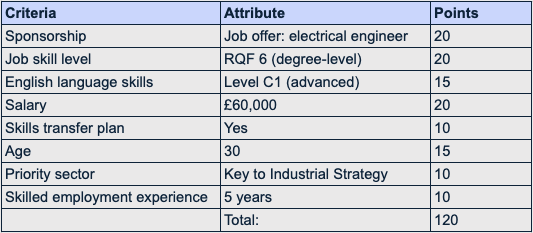
Rather than just fixed thresholds an applicant must exceed, the system could score points based on factors like the applicant's salary, skill level and experience, age, qualifications and sector of employment. It could also take into account the number of dependents, their language proficiency and skill level.
This would allow the government to recognise the skills, contribution and potential of applicants. Under such a system, those who do not currently meet the skill threshold, but who are highly valuable for the UK economy (for example, if they work in one of the Industrial Strategy’s growth-driving sectors), would be eligible for a visa. Those who significantly exceed the minimum requirements and score highly could be eligible for additional benefits such as a longer initial visa grant or a shorter qualifying period for permanent residency in line with the ‘Earned Settlement’ model proposed by the Immigration White Paper.
The Government could allocate additional points to applicants coming through the Work and Teach pathway. This could be conditional upon meeting some other criteria, such as a minimum salary or skill level, or a job offer from an SME.
The Government could also promote integration via the points-based system. Those who have demonstrated a significant commitment to Britain, such as passing the Life in the UK test or Advanced English proficiency, could be rewarded - the Government should consider this as part of its review into the test.
Table 1: Example points awarded to a Skilled Worker visa applicant
4) The introduction of a Migration Budget
While the Government wants to bring down net migration, it needs to do so in a way that is in line with its overall agenda. Restricting some immigration routes could undermine the Government’s ability to deliver its Industrial Strategy, or in fact boost the UK’s overall growth prospects.
A Migration Budget - in which the Government would publish the costs and benefits of migration in a given time period - would give the Government a way to regularly broker trade-offs across Whitehall and better explain the costs and benefits of different migration pathways. As part of this, the Government should set out its objectives for the immigration system and present to parliament an annual assessment of the costs and benefits of migration to the UK.
The Migration Budget would calculate migrants’ contributions to the public finances – such as through income tax, national insurance, visa fees and the immigration health charge – and subtract the costs they incur through welfare spending and use of public services. But net fiscal contributions are not the only factor in migration policy – the Migration Budget should also consider the social effects of different migration routes, like family visas, in line with the Government’s integration and community cohesion aims.
The Government could use the Migration Budget to more explicitly recognise some of the ways migration relates to domestic skills, including setting out how Immigration Skills Charge funding has been spent, or what studying migration means for UK students’ tuition fees. It could assess the benefits of the Teach and Learn pathway by calculating the wage cost of the time migrant workers have spent delivering their skills transfer plans. In the long run, as part of an evaluation of the Teach and Learn scheme, the Government could estimate the long-run financial returns for domestic workers who have received training via the pathway, and the additional tax revenue collected as a result.
Skills
4.2
1) Political prioritisation and communication of practical, lifelong skills reform
Skills reform wins back voters when it leads to practical outputs: more visible opportunity and money in people’s pockets. There is a strong case for policymakers to prioritise practical skills reform in their communications and prioritisation of policy creation. Too often, skills and training are seen as a nice-to-have. An additional buzzword to include in political speeches. It is, as our research shows, in fact central to cutting through to the public. But the way we speak about skills and training must also reject the traditional, complex nomenclature that is deeply entrenched in Westminster.
Our research clearly shows a public hungry for a strategy that offers practical skills reform that helps boost pay, security and dignity. The way we define skills is important; it is practical, not academic: life and trade trumps academic: when asked what “skills” means to them, trades came out top (52%), followed by digital (40%) and life skills (39%). Apprenticeships (defined as on-the-job training) came top when asked where the Government should prioritise skills spending; the workplace is where learning is most valued and it is in this setting that the government should frame the discussion: speak to lifelong learning that happens as part of a working career, and is accessible to every worker at every age and stage of their lives.
There is equally strong support for an industrial strategy-led approach aimed at supporting our emerging sectors - not just for national growth but for offering highly skilled and well-paying opportunities for every community in the UK. Some 79% of respondents in our polling believe we should encourage workers to take up careers in sectors facing shortages. These sectors face enormously tight l are able to provide highly skilled, higher paying opportunities, and empowering Brits to take part in this economy could be the key to practical transformation for thousands of would-be workers.
In changing the way politicians discuss skills, and ensuring it is woven through everything from housebuilding to transport, the Government can take that first step to meeting voters where they are: hungry for empowerment and opportunity.
2) Target Full Flexible Spend of the Growth and Skills Levy Toward IS-8 Sectors
Having laid out the public’s priorities for skills reform (in-work or college, practical, where it will boost wages, lifelong learning), we have overlaid those principles over the planned reform of the Growth and Skills Levy (GSL), modelling what output 100% flexibility would do in IS-8, without a floor for apprenticeship spending. The IS-8 are sectors that are associated with higher productivity, skills, wages and labour bottlenecks.
The Growth and Skills Levy, worth approximately £3.9 billion annually, is collected from businesses with revenues over £3 million. The Levy was initially proposed on a 50:50 model, so that half might be deemed by the Government as what can be spent on flexible training outside of apprenticeships. Whilst the Government has since moved away from proposals for such a model, we suggest there should, in fact, be greater emphasis on flexibility in some circumstances. We propose a more targeted approach for the Levy aimed at supporting full flexibility for the Industrial Strategy sectors (IS-8) identified in the Government’s Modern Industrial Strategy.
Specifically, we argue that firms in the IS8 industries should be able to spend 100% of their GSL contributions flexibly; spending on employees in the top ten ‘occupations in most critical and elevated demand’ (as defined by Skills England) could also be made completely flexible.
Our calculations indicate doing so could inject up to £9.6 billion into UK GDP, and create £805 million to £1.2 billion in headroom, if scored by the OBR.[3]
There could be guardrails drawn up in tandem with employers as to what constitutes effective skills and training for this spend, taking inspiration from the principles that apply to Apprenticeships and other approved courses like Skills Bootcamps. This is with the aim to maintain the quality of the courses provided and ensure the benefits to the individual, employer and wider economy are realised.
This reform would align the Levy with the sectors most critical to Britain’s economic future - including health and social care, construction, clean energy, digital, life sciences and advanced manufacturing - where skills shortages most constrain growth. Allowing firms in these industries to spend 100% of their Levy contributions flexibly on, for example, short courses, tailored bootcamps and in-work training would unlock hundreds of thousands of new training places each year, boost productivity and raise wages.
[3] Our economic impact analysis can be found as a supplementary paper published on our website: www.goodgrowthfoundation.co.uk/news/take-back-control-economic-impact-analysis.
3) Passing the bar for OBR scoring
Currently, the Office for Budget Responsibility (OBR) does not consider the current skills policy to pass the requisite criteria for scoring. By extension, there lies a political challenge that there is minimal economic reward for any sitting Chancellor to prioritise skills investment at any given fiscal event.
By prioritising skills policy that explicitly boosts productivity and growth, we believe that skills reform can and should be considered to pass the required criterion for being assessed positively by the OBR, and that skills reform that achieves these outcomes would be analogous to the NPPF reforms that were scored positively by the OBR at the last fiscal event. Building policy to this end - and submitting the required evidence - would thus provide the requisite political cover for prioritising skills reform.
Currently, the OBR does not ‘score’ skills investment because such policies often struggle to meet its criteria of significance, durability, additionality and evidence. This gap has discouraged innovation and contributed to long-term underinvestment in the workforce.
A focus on specific, evidence-based interventions - such as work-based training and lifelong learning where the outcome of each intervention is starkly noticeable —-and their measurable impact on productivity, employment and wages, rather than broad or long-term targets, should provide enough justification for the OBR to score skills policy.
For a new skills policy to be recognised by the OBR and thus have a measurable impact on the forecast, it must also pass an "additionality test," which requires a "substantial increase in either the level or effectiveness" of skills-related activity beyond the historical baseline. This is crucial because the OBR's historically-informed baseline implicitly captures an ongoing level of government effort to promote skills. The Government could pass this test by providing detailed data to the OBR on tangible outputs from skills investment, such as new training places created and new employment outcomes.
This would allow the OBR to quantify the fiscal benefits of skills reform, including higher tax receipts, reduced welfare spending and stronger GDP growth, ensuring that investment in people is recognised as a means for increasing headroom and a core driver of Britain’s economic and fiscal strength.
4) Applying these principles for other high-impact priority projects
A highly targeted approach that provides the additional bonus of positive OBR scoring is a principle that can be applied across an array of appealing policies in this space.
We propose two additional measures that, where explored further, could also provide the necessary economic boost for ensuring skills reform is a key driver for good growth:
Additional flexibility and ringfencing for capital projects: Another means by which wages and productivity are likely to be positively impacted is by offering the same levels of flexibility we propose above, specifically to major infrastructure projects, which are also facing up to the challenge of tight labour markets. The government are injecting enormous amounts of funding into key projects, to the sum of up to £725bn as part of the 10-year Infrastructure Strategy. Critical infrastructure projects could be given greater rein to spend a part of this as they see fit on upskilling and recruitment to staff key projects. The government should mandate that a minimum percentage of the total capital expenditure on large projects can be ring-fenced for skills and training. This percentage would be agreed upon during the project's early planning stages, ensuring the training budget scales automatically with the project's scope and costs, providing inherent flexibility. This would provide a consistent and robust funding mechanism for domestic training.
For example, a project like Sizewell C, which is expected to employ 600 people at the start and climb to 70,000 by operation, could have a skills budget that grows with the project, providing a greater number of new recruits or training places than currently expected. Eligible expenditures could include bursaries for local trainees, grants for colleges, and direct investment in training facilities and equipment.
Other measures to consider could also be to tie the Youth Jobs Guarantee to Infrastructure Projects, allowing for spending to go into the recruitment of long-term economically inactive young people.
By tying key infrastructure projects to the provision of local opportunity, we can make a key part of government policy tangible and real for ordinary people.
Further flexible and targeted support for SMEs: The Government should also consider means for further boosting the offer available to small and medium-sized enterprises (SMEs) - who make up 60% of total private sector employment - in the Industrial Strategy (IS-8) sectors to invest more in skills and training.
Voters are clear that they do not feel enough opportunities exist for advancement, and employers are seen as offering too few routes for training. Yet business investment in skills has sharply declined - falling from £4,420 per trainee in 2011 to £2,710 in 2024, and from £2,410 per employee to £1,700 over the same period. Smaller businesses in particular face a squeeze of resources that restricts their ability to provide or maintain training, but also make up the majority of employment in the UK.
Targeted support for small and medium-sized employers in the IS-8 could help reverse this trend, stimulating new spending rather than replacing training that would have happened anyway. By supporting the firms that power Britain’s growth industries, this policy would make investment in people a core part of national industrial renewal, whilst acknowledging the significant existing cost barriers that face smaller employers right across the IS-8 supply chain.
[4] CP 1344 – UK Infrastructure: A 10 Year Strategy.” GOV.UK, 11 June 2025, https://assets.publishing.service.gov.uk/media/6853c5db99b009dcdcb73649/UK_Infrastructure_A_10_Year_Strategy_Web_Accessible.pdf.

Appendix
Economic Analysis
Our economic impact analysis has been published as a seperate paper on our website, please follow the link to read.
Polling Data
Please see our Polling Archive for our full tables.

With special thanks to…
Arthur Fyfe-Stoica
Saskia Poulter
Sachin Savur
Dylan Turner
Jade Azim
Theresa Bischof
Billie Coulson
Louisa Dollimore